

The front squat is a fundamental strength-training exercise that enhances lower-body strength, core stability, and overall movement efficiency. Unlike the back squat, the front-loaded position places greater emphasis on the quadriceps, core, and upper back, making it an effective variation for improving posture and muscle balance.
Understanding the proper form and technique is essential to maximize performance while reducing the risk of injury.
Benefits of Front Squats
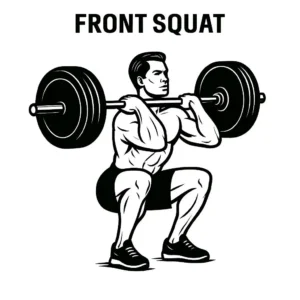
Front squats offer several advantages over other squat variations:
- Increased Quad Activation – The front-loaded barbell shifts emphasis to the quadriceps, making it an ideal exercise for building leg strength.
- Enhanced Core Engagement – Holding the weight in front forces the core muscles to work harder for stability.
- Improved Posture and Mobility – Requires an upright torso, promoting better spinal alignment and flexibility.
- Reduced Lower Back Strain – Places less compression on the lumbar spine compared to back squats.
- Better Transfer to Olympic Lifts – Essential for movements like cleans and snatches in weightlifting.
How to Perform a Front Squat Correctly
Executing the front squat with proper form ensures optimal muscle activation and injury prevention.
1. Set Up Your Stance
- Stand shoulder-width apart with feet slightly turned out.
- Position the barbell across the front of the shoulders, resting on the deltoids and collarbone.
- Keep elbows high, pointing forward, ensuring the bar stays in place.
2. Engage Core and Descend
- Take a deep breath and brace the core.
- Lower into a squat by bending the knees and hips simultaneously.
- Keep the chest upright and maintain a straight spine.
- Lower until thighs are parallel to the ground or deeper, depending on mobility.
3. Drive Back to Standing
- Push through the heels and midfoot while maintaining posture.
- Extend the knees and hips simultaneously.
- Keep the elbows high throughout the movement to prevent bar slippage.
Common Mistakes to Avoid
- Dropping the elbows – Causes the barbell to roll forward, affecting balance.
- Leaning forward – Reduces quad engagement and increases lower back strain.
- Heels coming off the ground – Indicates a lack of mobility or improper weight distribution.
Front Squat vs. Back Squat
Understanding the differences between the front squat and back squat helps determine which variation suits specific training goals.
| Feature | Front Squat | Back Squat |
| Bar Position | Front of shoulders | Upper back |
| Muscle Emphasis | Quadriceps, Core | Glutes, Hamstrings |
| Posture | Upright torso | Slight forward lean |
| Spinal Load | Less lower back strain | Higher lower back engagement |
| Mobility Requirement | High | Moderate |
Both variations are effective for leg strength and hypertrophy, but front squats are preferable for quad dominance, core engagement, and reduced spinal stress.
Muscles Worked in the Front Squat
The front squat targets multiple muscle groups:
- Quadriceps – Primary muscles responsible for knee extension.
- Glutes – Engaged at the bottom of the squat for hip extension.
- Hamstrings – Assist in stabilizing the knee and hip.
- Core Muscles – Maintain balance and control throughout the movement.
- Upper Back (Trapezius & Deltoids) – Keep the barbell secure in position.
Front Squat Variations
Modifying the front squat can increase difficulty or accommodate different fitness levels:
- Dumbbell Front Squat – Uses dumbbells instead of a barbell, requiring greater stabilization.
- Goblet Squat – A beginner-friendly option holding a single kettlebell or dumbbell at chest level.
- Paused Front Squat – Incorporates a brief pause at the bottom to improve control and strength.
- Front Box Squat – Uses a box to reinforce proper depth and mechanics.
How Many Front Squats Should Be Done per Workout?
The number of front squat sets and reps depends on training goals:
- Strength – 4–5 sets of 3–6 reps with heavy weight.
- Hypertrophy (Muscle Growth) – 3–4 sets of 8–12 reps with moderate weight.
- Endurance & Mobility – 2–3 sets of 12–15 reps with lighter weight.
Front squats can be performed 1–3 times per week, depending on recovery and overall workout volume.
Conclusion
Front squats are a highly effective lower-body exercise that strengthens the quadriceps, core, and upper back while improving posture and mobility. Maintaining proper form is crucial for maximizing performance and safety. By incorporating variations, adjusting rep schemes, and avoiding common mistakes, lifters can fully benefit from this powerful squat variation.
Written By

Join thousands of readers leveling up their fitness.
Skip the guesswork—get insights on training, health, and the right gear to support your progress.
You may also like
10 Best Hamstring Exercises To Strengthen Your Legs
Strong hamstrings are essential for powerful, balanced, and injury-free legs.…
8 Assault Bike Workouts For Every Fitness Goal
The assault bike, also known as the air bike, is one of the most effective…

How to Start Lifting Weights: A Beginner’s Guide
Starting weightlifting can feel intimidating, but it’s one of the most…
7 Best Hip Stretches To Improve Both Pain And Mobility
Tight hips are a common issue for anyone who spends long hours sitting or…

What Is Hybrid Training & How to Build a Hybrid Program
Hybrid training is one of the most effective ways to build a strong, athletic,…

How To Improve Your Grip Strength
A strong grip is more than just a sign of power — it’s a foundation for better…