

The Arnold Press is one of those exercises that looks simple at first, but becomes much more demanding once you perform it correctly. Popularized by bodybuilding legend Arnold Schwarzenegger, the movement combines a traditional dumbbell shoulder press with a controlled rotation that changes the position of the hands throughout the exercise.
That rotation is what makes the Arnold Press different from a standard dumbbell shoulder press. Instead of beginning with your palms facing forward, you start with the dumbbells in front of your shoulders and your palms facing toward you. As you press the weights overhead, you rotate your hands outward until your palms face forward at the top.
The result is a shoulder exercise that requires strength, control, coordination, and stability throughout the entire movement.
For lifters focused on building stronger and more developed shoulders, the Arnold Press can be a useful addition to a well-rounded training program. However, it is not simply a matter of adding more weight and pressing overhead. Because the exercise combines pressing and rotation, proper technique is especially important.
This guide explains what the Arnold Press is, the muscles worked by the movement, its potential benefits, how to perform it correctly, common mistakes to avoid, and how to decide whether the seated or standing version is right for you.
What Is the Arnold Press?
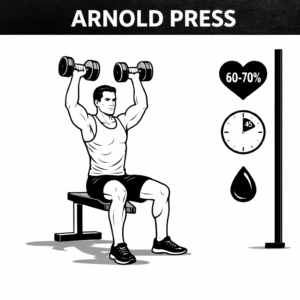
The Arnold Press is a dumbbell shoulder exercise that combines an overhead press with an outward rotation of the arms.
The exercise is typically performed while seated on a bench with back support, although it can also be performed while standing. You begin with the dumbbells held in front of your shoulders, palms facing your body. From there, you press the weights upward while rotating your hands outward. By the time your arms reach the top of the movement, your palms should be facing forward.
You then reverse the movement under control, rotating the dumbbells back toward your body as you lower them.
Compared with a traditional dumbbell shoulder press, the Arnold Press uses a longer movement pattern. You are not simply pressing the dumbbells straight up and down. Your arms change position as you move through each repetition, which requires greater control and coordination.
The exercise is often associated with shoulder development, but the muscles worked by the Arnold Press extend beyond the deltoids. Your triceps help extend the elbows, while several smaller muscles contribute to shoulder stability and control.
Because of this, the Arnold Press can fit well into workouts focused on muscle growth, general upper-body strength, and shoulder development.
How to Do the Arnold Press Correctly
Good technique is more important than the amount of weight you can lift. The rotational component of the exercise means that using dumbbells that are too heavy can make it difficult to maintain control.
1. Set up your position
Sit on a bench with your feet firmly planted on the floor. If possible, use a bench with back support so you can maintain a stable torso throughout the movement.
Hold one dumbbell in each hand and bring them up to shoulder level. Your elbows should be bent, with the dumbbells positioned in front of your shoulders.
At the starting position, your palms should face toward your body.
Keep your chest up and your core engaged. Avoid leaning backward to create momentum.
2. Begin the rotation and press
Start pressing the dumbbells upward while slowly rotating your hands outward.
The movement should be smooth rather than divided into two separate actions. You are rotating and pressing at the same time.
As the dumbbells move upward, your elbows gradually move out to the sides. Keep the movement controlled and avoid allowing the weights to swing away from your body.
3. Reach the top position
Continue pressing until your arms are extended overhead without forcing the elbows into an aggressive lockout.
At the top, your palms should be facing forward. Your arms should be positioned comfortably overhead rather than excessively far behind your head.
Pause briefly if it helps you maintain control and feel the shoulders working.
4. Lower the weights slowly
Begin lowering the dumbbells while reversing the rotation.
As the weights come down, your palms should gradually turn back toward your body. Return to the original position with the dumbbells in front of your shoulders.
Do not allow gravity to control the lowering phase. A controlled descent keeps the movement deliberate and helps you maintain proper positioning.
Arnold Press Muscles Worked
The main muscles worked by the Arnold Press are the muscles of the shoulders, particularly the deltoids. However, the exercise also requires assistance from several other upper-body muscles.
Deltoids
The deltoids are the primary muscles involved in the Arnold Press. The deltoid is divided into three sections: the anterior deltoid at the front of the shoulder, the lateral deltoid on the side, and the posterior deltoid at the rear.
The anterior deltoid plays an important role in the pressing portion of the exercise. The lateral deltoid contributes as the arms move outward and overhead, helping create the broader shoulder appearance many lifters want.
The rear deltoid is involved in shoulder positioning and control, although the Arnold Press should not be considered a replacement for exercises specifically designed to emphasize the rear delts.
This is why the dumbbell Arnold Press muscles worked can include different portions of the shoulder throughout the movement rather than placing all of the emphasis on a single area.
Triceps
Your triceps assist with extending the elbows as the dumbbells are pressed overhead. They are not the main target of the Arnold Press, but they contribute significantly to the pressing motion.
If your goal is overall upper-body strength, this additional involvement can make the exercise useful alongside other pressing movements.
Upper Trapezius
The upper trapezius helps support and control the shoulder girdle during overhead movement. It works together with other muscles around the shoulder blade to help maintain proper positioning as the arms move overhead.
Rotator Cuff Muscles
The rotator cuff consists of several smaller muscles that help stabilize the shoulder joint. Because the Arnold Press involves both pressing and rotation, these muscles contribute to controlling the movement.
This does not mean the Arnold Press should replace dedicated shoulder stability or rotator cuff exercises. Instead, it means the exercise requires your shoulders to remain stable while moving through a larger range of motion.
Serratus Anterior
The serratus anterior can also contribute to the movement by helping control the shoulder blade as the arms move overhead. Its involvement is secondary, but it plays an important role in healthy shoulder mechanics.
What Are the Benefits of the Arnold Press?
The Arnold Press can offer several benefits when performed with appropriate weight and technique.
It Trains the Shoulders Through a Larger Movement
One of the main differences between the Arnold Press and a traditional dumbbell shoulder press is the movement pattern.
The hands begin in front of the shoulders and rotate outward as the dumbbells travel overhead. This creates a longer and more dynamic range of motion.
For lifters who have already become comfortable with traditional presses, the Arnold Press can provide a different training stimulus and add variety to a shoulder-focused workout.
It Can Support Shoulder Muscle Development
The deltoids do most of the work during the exercise, making the Arnold Press a useful option for people looking to develop their shoulders.
Well-developed shoulders contribute to overall upper-body proportions and can create a broader appearance through the upper body. Building the shoulders effectively, however, requires more than one exercise. The Arnold Press works best as part of a balanced program that includes different movements and appropriate recovery.
It Requires Control and Stability
The Arnold Press is not just a strength exercise. Because the dumbbells rotate throughout the repetition, you need to control their position from beginning to end.
That means your shoulders, arms, and core need to work together to keep the movement stable. Performing the exercise slowly and deliberately can help you develop better control rather than relying on momentum.
It Adds Variety to Shoulder Training
Doing the same shoulder press in every workout can become repetitive. The Arnold Press gives you another option without requiring complicated equipment.
It can be especially useful when you want to change the stimulus of your shoulder workout while continuing to use dumbbells.
It Can Improve Your Awareness of Shoulder Position
The rotating movement requires you to pay attention to how your elbows, wrists, and shoulders move throughout each repetition.
That makes the exercise a good opportunity to practice controlled movement. However, this benefit depends on using a manageable weight and maintaining good technique.
Seated vs. Standing Arnold Press
The Arnold Press can be performed either seated or standing. Neither version is automatically better. The right choice depends on your goals, experience, and ability to maintain good form.
Seated Arnold Press
The seated version is generally the better option when your priority is keeping the movement focused on the shoulders.
A bench with back support provides additional stability and reduces the amount of balance required from the rest of your body. This makes it easier to concentrate on the pressing and rotation.
The seated Arnold Press can be particularly useful for hypertrophy-focused training because you can reduce unnecessary movement and concentrate on controlling each repetition.
If you are still learning the exercise, starting with the seated version can also make it easier to understand the movement pattern.
Standing Arnold Press
The standing Arnold Press requires more involvement from your core and lower body to keep your body stable.
Because there is no bench supporting your torso, you have to maintain your posture throughout the entire set. This can make the movement feel more demanding even when you are using the same dumbbell weight.
The standing version can be useful for experienced lifters who want an additional stability challenge. However, it is important not to turn the exercise into a full-body movement by using your legs or leaning backward to push the weights overhead.
For most people, the seated variation is a practical starting point. Once you can perform the movement consistently, you can experiment with the standing version if it fits your training goals.
Common Arnold Press Mistakes
The Arnold Press becomes much less effective when technique starts breaking down. Several mistakes are particularly common.
Using Too Much Weight
The most common mistake is choosing dumbbells that are too heavy.
The Arnold Press involves rotation and requires control throughout the entire repetition. Heavy dumbbells can make it difficult to maintain the correct starting position and smooth rotation.
Choose a weight that allows you to control both the lifting and lowering phases. Progress gradually rather than treating every set as a test of maximum strength.
Arching the Lower Back
When a weight becomes too challenging, it is common to lean backward and exaggerate the lower-back arch.
This changes the movement and can place unnecessary stress on the lower back.
Keep your core engaged and maintain a stable torso. If you cannot press the dumbbells overhead without leaning back, reduce the weight.
Rushing the Rotation
The rotation is an important part of the exercise. Moving too quickly can make the exercise feel uncontrolled and can cause your hands, elbows, and shoulders to move out of position.
There is no advantage to rushing through the repetition. Move smoothly and deliberately.
Dropping the Elbows Too Far
Lowering the dumbbells excessively can make it harder to maintain tension and may put your shoulders into a position that does not feel comfortable.
Instead of forcing a specific depth, use a range of motion that you can control comfortably while maintaining proper shoulder and torso position.
Using Momentum
Swinging the dumbbells or using your legs to create momentum takes work away from the target muscles.
The goal is to make the shoulders and supporting muscles perform the movement rather than allowing momentum to carry the weights.
How to Make the Arnold Press Safer
Start every shoulder workout with an appropriate warm-up. Light arm movements, controlled shoulder circles, and band pull-aparts can help prepare the upper body for training.
You should also begin the Arnold Press with a lighter weight than you might normally use for a standard dumbbell shoulder press. The additional rotation changes the exercise and can make even moderate weights challenging.
Throughout the set, focus on maintaining control. Your wrists should remain stable, your torso should stay controlled, and your shoulders should move naturally rather than being forced into an uncomfortable position.
If you experience sharp or unusual pain in the shoulder, neck, or surrounding area, stop the exercise. Discomfort caused by normal muscular effort is different from pain that may indicate a problem.
Good technique should always come before adding weight.
Arnold Press Variations and Alternatives
The Arnold Press is not the only way to train the shoulders. Depending on your goals, other exercises may be better suited to a particular workout.
The standard dumbbell shoulder press is a simpler movement and can make it easier to focus on building pressing strength.
The barbell overhead press allows you to work with heavier loads and is often used as a primary strength exercise.
The Z-Press is performed while sitting on the floor and places greater demands on mobility, posture, and core control.
A cable shoulder press provides another option for lifters who prefer cable resistance and want a different feel throughout the movement.
You do not need to perform every variation in the same workout. Choose exercises that complement your goals and allow you to train consistently.
Final Thoughts
The Arnold Press remains a useful shoulder exercise because it combines pressing strength with controlled rotation. Its distinctive movement pattern gives it a place in workouts designed to build stronger, more developed shoulders while adding variety to traditional pressing exercises.
The key is not to chase heavy weights. The value of the Arnold Press comes from controlling the entire movement, starting with a stable position, rotating smoothly, pressing with purpose, and reversing the motion without losing control.
If you are new to the exercise, begin with the seated version and use a manageable weight. Once the movement feels natural, you can gradually increase the resistance or experiment with the standing variation.
Most importantly, remember that the Arnold Press is one exercise, not a complete shoulder program. Combine it with other well-chosen movements, maintain good training habits, and give your muscles enough time to recover.
When performed correctly, the Arnold Press can be a valuable addition to your routine and a practical way to challenge.
Last Updated on August 28, 2026
Written By

Join thousands of readers leveling up their fitness.
Skip the guesswork—get insights on training, health, and the right gear to support your progress.
You may also like
How To Do A Lat Pulldown Correctly
The lat pulldown is one of the best exercises for building a wider, stronger…
10 Different Types Of Deadlifts And Their Benefits
The deadlift is one of the most powerful compound exercises for building…

How to Strengthen Your Knees for Running
Strong, healthy knees are essential for runners, whether you’re logging miles…

Compound vs. Isolation Exercises: What’s the Difference?
When it comes to strength training, all exercises can generally be divided into…
Back Squat Exercise Guide: How to Master Back Squats
The back squat is one of the most effective strength training exercises for…
10 Medicine Ball Ab Exercises You Need To Try
If you’re tired of traditional crunches and planks, it’s time to add some…