

Shoulder stiffness can affect far more than your workouts. It can make everyday activities such as reaching for a shelf, lifting groceries, fastening a seatbelt, or even getting dressed feel uncomfortable. While many people associate shoulder discomfort with aging or intense exercise, limited shoulder mobility often develops gradually due to long hours at a desk, repetitive movements, poor posture, or a lack of regular stretching and strengthening.
The shoulder is one of the most complex joints in the human body. Its remarkable range of motion allows you to lift, push, pull, throw, and rotate your arms in almost every direction. However, this freedom of movement also makes the shoulder more vulnerable to stiffness, muscle imbalances, and injury when it is not properly maintained.
Improving shoulder mobility is not just about becoming more flexible. Healthy mobility means your shoulder can move through its full range of motion while remaining stable and controlled. This combination helps you perform better during exercise, reduces unnecessary strain on surrounding muscles and joints, and lowers your risk of common shoulder problems.
Whether you are an athlete looking to improve performance, someone returning to exercise after time away, or simply hoping to move without discomfort, adding shoulder mobility exercises to your routine can make a noticeable difference. Even spending ten to fifteen minutes a few times each week can improve posture, restore movement, and help you perform daily tasks with greater ease.
This guide explores why shoulder mobility matters, how it affects your overall movement, and the best shoulder mobility exercises to help increase flexibility, improve joint function, and support long-term shoulder health.
Why Shoulder Mobility Matters
Many people assume shoulder flexibility and shoulder mobility are the same thing, but they are different. Flexibility refers to the ability of muscles to lengthen, while mobility describes how well a joint moves through its full range of motion with strength and control.
Healthy shoulders depend on both.
Your shoulder joint works together with the shoulder blade, collarbone, upper back, and surrounding muscles every time you move your arm. If one part of this system becomes tight or weak, the entire movement pattern can be affected. Over time, these small restrictions may lead to poor posture, reduced strength, and discomfort during everyday activities or exercise.
Modern lifestyles contribute significantly to limited shoulder mobility. Sitting for extended periods, working at a computer, frequently looking down at phones, and spending less time performing varied physical movements all encourage rounded shoulders and tight chest muscles. These changes gradually reduce overhead movement and place additional stress on the shoulder joint.
For people who exercise regularly, poor mobility often limits performance before strength becomes the problem. You may struggle to perform overhead presses correctly, achieve proper squat positioning, or complete pull-ups with good form. Instead of targeting the intended muscles, your body compensates by placing unnecessary stress on other joints and tissues.
Improving shoulder mobility provides benefits that extend well beyond the gym. Better mobility can help you:
- Move through everyday activities with greater comfort.
- Improve posture by reducing excessive rounding of the shoulders.
- Increase efficiency during strength training and sports.
- Reduce unnecessary stress on the neck and upper back.
- Improve lifting technique during compound exercises.
- Lower the likelihood of developing overuse injuries.
Perhaps the greatest advantage is that improved mobility creates a stronger foundation for overall movement. Strength built on limited mobility often reinforces poor movement patterns, while strength developed through a healthy range of motion promotes better long-term joint health.
8 Best Shoulder Mobility Exercises
1. Shoulder Pass-Throughs
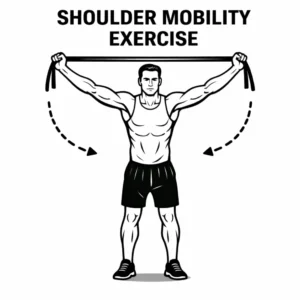
Shoulder pass-throughs are one of the most effective mobility exercises for improving overhead range of motion. They gently stretch the chest, shoulders, and upper back while encouraging smooth movement throughout the shoulder joint.
This exercise is especially helpful for people who spend much of the day sitting at a desk because it helps reverse the forward shoulder position that commonly develops from prolonged computer work.
To perform the exercise, hold a PVC pipe, broomstick, or resistance band with a wide grip in front of your body. Keeping your elbows straight, slowly raise the stick overhead and continue moving until it passes behind your back as far as your mobility comfortably allows. Reverse the movement using the same controlled pace until you return to the starting position.
The key is maintaining slow, even movement rather than rushing through repetitions. If you struggle to complete the motion comfortably, widen your grip until you can perform the exercise without compensating through your lower back.
Complete 10 to 15 slow repetitions while focusing on smooth movement rather than speed.
2. Wall Slides
Wall slides are excellent for improving shoulder mobility while simultaneously strengthening the muscles responsible for stabilizing the shoulder blades. Unlike passive stretching, this exercise teaches your body how to control movement throughout the entire range of motion.
Begin by standing with your back against a wall. Your head, upper back, and hips should remain in gentle contact with the surface. Position your arms in a “W” shape with your elbows bent and your forearms resting against the wall.
Slowly slide your arms upward until they form a “Y” shape above your head while maintaining as much contact with the wall as possible. Pause briefly before lowering your arms back to the starting position.
Many people notice one arm moves more freely than the other during this exercise. This is completely normal and often highlights existing muscle imbalances that improve with regular practice.
Perform 10 slow repetitions while concentrating on maintaining proper posture throughout the movement.
3. Thread the Needle
Although often considered a stretch for the upper back, Thread the Needle is also one of the best shoulder mobility exercises because it improves thoracic spine rotation. Healthy movement through the upper back allows the shoulders to function more efficiently during both daily activities and athletic performance.
Start on your hands and knees with your spine in a neutral position. Slowly slide your right arm underneath your left arm, allowing your upper body to rotate naturally toward the floor. Continue reaching until your shoulder and the side of your head gently rest on the ground.
Pause in this position while taking slow, controlled breaths. With each breath, allow your muscles to relax naturally without forcing additional rotation.
After holding for twenty to thirty seconds, slowly return to the starting position before repeating on the opposite side.
This exercise is particularly beneficial for individuals experiencing stiffness across the upper back or discomfort after long periods of sitting. By improving rotational mobility, it supports healthier shoulder movement while also helping reduce tension throughout the neck and upper spine.
Repeat the stretch twice on each side while maintaining slow, controlled breathing.
4. Sleeper Stretch
The Sleeper Stretch is one of the most effective exercises for improving internal shoulder rotation, a movement that is often limited in people who regularly perform overhead activities such as swimming, tennis, baseball, volleyball, CrossFit, or weightlifting. It is also beneficial for office workers whose shoulders spend long hours in a rounded position.
Limited internal rotation can affect pressing movements, overhead lifting, and even simple daily activities. Restoring this range of motion helps the shoulder move more naturally while reducing unnecessary stress on the surrounding muscles and tendons.
To perform the Sleeper Stretch, lie on one side with your bottom shoulder and hip stacked directly on top of each other. Extend your bottom arm straight in front of you, then bend your elbow to form a 90-degree angle. Your forearm should point toward the ceiling.
Using your opposite hand, gently guide the forearm toward the floor. Apply only light pressure until you feel a comfortable stretch at the back of your shoulder. Avoid forcing the movement or pressing through discomfort, as excessive pressure can irritate the shoulder rather than improve mobility.
Hold the stretch for 20 to 30 seconds while breathing slowly. Repeat two or three times before switching sides.
The goal is to improve movement gradually. A gentle stretch performed consistently over several weeks is far more effective than trying to gain additional range in a single session.
5. Doorway Stretch
Tight chest muscles are one of the most common causes of poor shoulder mobility. Spending hours at a computer, driving, or looking down at a phone encourages the shoulders to roll forward, shortening the muscles across the front of the chest. Over time, this posture limits overhead movement and places additional strain on the neck and upper back.
The Doorway Stretch is a simple but highly effective way to counteract these effects.
Stand inside a doorway and place both forearms against the frame with your elbows positioned roughly at shoulder height. Step forward slowly until you feel a comfortable stretch across your chest and the front of your shoulders.
Keep your head aligned with your spine and avoid arching your lower back. The movement should come from stepping forward rather than leaning your entire body through the doorway.
Hold the position for 20 to 30 seconds before relaxing. Repeat two or three times.
If one shoulder feels tighter than the other, perform the stretch one arm at a time. This allows you to focus on the side that requires more attention while maintaining proper alignment throughout the movement.
When performed consistently, the Doorway Stretch can improve posture, reduce upper body tightness, and create more comfortable overhead movement.
6. Shoulder CARs (Controlled Articular Rotations)
Shoulder CARs, short for Controlled Articular Rotations, are among the best exercises for maintaining healthy shoulder joints because they actively move the shoulder through its fullest pain-free range of motion.
Unlike traditional stretches that simply lengthen muscles, CARs improve joint awareness, coordination, and control. They also help identify movement restrictions before they develop into more significant mobility problems.
Begin by standing tall with your feet shoulder-width apart. Tighten your core to prevent your torso from twisting during the exercise. Slowly raise one arm in front of you, continuing overhead before rotating it behind your body and returning it to the starting position in one smooth circular motion.
The movement should remain slow and controlled from beginning to end. Imagine drawing the largest circle possible with your fingertips while keeping the rest of your body completely still.
Complete five controlled circles in one direction before reversing the movement.
Although the exercise appears simple, quality is far more important than speed. Smaller circles performed with complete control provide greater benefit than large circles completed using momentum.
Including Shoulder CARs in your daily routine helps maintain healthy joint function while preparing the shoulders for lifting, throwing, reaching, and other demanding activities.
7. Band Pull-Aparts
Strong upper back muscles are essential for healthy shoulder movement. Unfortunately, these muscles are often weaker than the muscles across the front of the chest due to modern sitting habits and repetitive forward-reaching activities.
Band Pull-Aparts strengthen the muscles between the shoulder blades while encouraging better posture and improved shoulder stability.
Hold a light resistance band with both hands positioned approximately shoulder-width apart. Extend your arms straight in front of your chest while keeping a slight bend in your elbows.
Pull the band apart by squeezing your shoulder blades together rather than simply moving your hands outward. Continue until the band reaches your chest, then slowly return to the starting position under control.
Avoid shrugging your shoulders during the movement. Your shoulders should remain relaxed while the muscles between your shoulder blades perform most of the work.
Complete 12 to 15 repetitions using slow, controlled movement.
Although this exercise is commonly used during warm-ups, it is equally effective as part of a rehabilitation program or daily posture routine. Regular practice helps balance the muscles surrounding the shoulder joint, making other shoulder mobility exercises even more effective.
8. Scapular Wall Push-Ups
Healthy shoulders rely on more than flexibility alone. The muscles responsible for controlling the shoulder blades must also function correctly to provide stability during movement.
Scapular Wall Push-Ups strengthen these important stabilizing muscles without placing excessive stress on the shoulder joint.
Stand facing a wall at approximately arm’s length. Place your hands flat against the wall at shoulder height while keeping your elbows straight.
Instead of bending your elbows like a traditional push-up, slowly allow your chest to move toward the wall by bringing your shoulder blades together. Then press through your hands and spread your shoulder blades apart as far as comfortably possible.
The movement is relatively small but highly effective for improving shoulder blade control.
Perform 10 to 15 slow repetitions while focusing on smooth movement rather than speed.
Although often overlooked, proper scapular movement plays an important role in nearly every upper-body exercise. Improving shoulder blade control can enhance lifting technique, reduce unnecessary joint stress, and contribute to healthier long-term shoulder function.
When and How Often Should You Do Shoulder Mobility Exercises?
One of the biggest advantages of shoulder mobility training is that it doesn’t require hours in the gym. A consistent routine of just 10 to 15 minutes, performed several times a week, is enough for most people to notice meaningful improvements in their range of motion, posture, and overall shoulder comfort.
The best time to perform shoulder mobility exercises depends on your goals. Before a workout, mobility exercises prepare the joints and surrounding muscles for movement. Dynamic exercises such as Shoulder CARs, Wall Slides, and Band Pull-Aparts increase blood flow, activate stabilizing muscles, and improve movement quality before lifting weights or participating in sports.
After a workout, your muscles are already warm, making it an ideal time to include stretches such as the Doorway Stretch, Thread the Needle, and the Sleeper Stretch. These movements can help reduce post-workout stiffness while gradually improving flexibility over time.
People who spend long hours sitting at a desk may also benefit from performing a short mobility routine during the day. Even five minutes of gentle movement every few hours can help reduce muscle tightness caused by prolonged sitting and improve posture throughout the workday.
The key is consistency rather than intensity. Mobility develops through regular practice. Trying to perform an hour of stretching once a week will rarely produce the same results as completing a short routine four or five times each week.
Expert Tips for Improving Shoulder Mobility Faster
Developing healthy shoulders involves more than following a list of exercises. Small lifestyle habits often determine how quickly you see progress.
Begin by making mobility part of your regular routine rather than treating it as something you only do when your shoulders feel stiff. Consistency builds lasting improvements and helps prevent tightness from returning.
Focus on your breathing during every movement. Slow, controlled breathing encourages the muscles to relax and often allows a slightly greater range of motion without forcing the stretch. Holding your breath tends to increase muscle tension and reduce movement quality.
Balance mobility work with strength training. Flexible shoulders without adequate muscular support can become unstable, while strong muscles with limited mobility restrict movement. Combining mobility exercises with strengthening movements such as rows, face pulls, and controlled pressing exercises creates healthier, more resilient shoulders.
Pay attention to your daily posture as well. Small adjustments, such as keeping your shoulders relaxed, positioning your monitor at eye level, and taking regular movement breaks during the day, help reinforce the mobility gains you achieve through exercise.
Most importantly, be patient. Shoulder mobility is built gradually through consistent effort. Small improvements made week after week eventually lead to noticeable changes in movement quality, posture, exercise performance, and overall comfort.
Common Mistakes That Can Limit Shoulder Mobility
Many people practice mobility exercises consistently but fail to see progress because of a few common mistakes. Correcting these habits can make your routine significantly more effective.
One of the biggest mistakes is confusing mobility with flexibility. While stretching tight muscles is beneficial, shoulder mobility also depends on joint control and muscular stability. Focusing only on passive stretching without strengthening the surrounding muscles often leads to temporary improvements that quickly disappear.
Another common mistake is forcing a greater range of motion than your body can safely control. Shoulder mobility should never involve sharp pain or aggressive stretching. Moving too aggressively can irritate tendons, place unnecessary stress on the joint, and delay progress. Instead, work within a comfortable range and allow your mobility to improve gradually over time.
Many people also move too quickly through their exercises. Mobility training is about quality rather than quantity. Slow, controlled movements allow the muscles and nervous system to develop better coordination while improving joint stability. Rushing through repetitions often causes the body to compensate with poor posture or unnecessary movement from the lower back and neck.
Ignoring posture outside of exercise is another obstacle. Even the best shoulder mobility routine will have limited long-term benefits if you spend eight or ten hours every day sitting with rounded shoulders and a forward head position. Paying attention to your posture throughout the day helps reinforce the improvements you make during your mobility sessions.
Finally, many individuals stop performing mobility exercises as soon as they begin feeling better. Just like strength training, mobility should become part of your regular fitness routine. Maintaining healthy movement is often easier than trying to restore it after stiffness returns.
Conclusion
Healthy shoulders are essential for far more than athletic performance. Nearly every upper-body movement, from lifting groceries and reaching into a cabinet to performing strength exercises and recreational sports, depends on good shoulder mobility. When your shoulders move freely and remain stable throughout their full range of motion, everyday tasks become easier and exercise becomes both safer and more effective.
The eight shoulder mobility exercises covered in this guide provide a balanced approach to improving flexibility, strengthening stabilizing muscles, and restoring natural movement patterns. Together, they address many of the common mobility limitations caused by poor posture, repetitive movement, prolonged sitting, and demanding training programs.
Remember that improving mobility is not about achieving dramatic results overnight. Lasting progress comes from performing quality movements consistently while respecting your body’s current range of motion. Even a short routine completed several times each week can gradually improve posture, reduce stiffness, enhance lifting performance, and lower your risk of future shoulder problems.
Instead of waiting until discomfort begins to interfere with your daily life, make shoulder mobility a regular part of your fitness routine. By investing a few minutes in your shoulder health today, you can improve the way you move, train, and perform for years to come.
Last Updated on August 27, 2026
Written By

Join thousands of readers leveling up their fitness.
Skip the guesswork—get insights on training, health, and the right gear to support your progress.
You may also like

How To Do A Lat Pulldown Correctly
The lat pulldown is one of the best exercises for building a wider, stronger…

10 Different Types Of Deadlifts And Their Benefits
The deadlift is one of the most powerful compound exercises for building…

How to Strengthen Your Knees for Running
Strong, healthy knees are essential for runners, whether you’re logging miles…

Compound vs. Isolation Exercises: What’s the Difference?
When it comes to strength training, all exercises can generally be divided into…
Back Squat Exercise Guide: How to Master Back Squats
The back squat is one of the most effective strength training exercises for…

10 Medicine Ball Ab Exercises You Need To Try
If you’re tired of traditional crunches and planks, it’s time to add some…