

If you want to build an upper body that looks powerful from every angle, your trapezius muscles deserve just as much attention as your chest, shoulders, and arms. Commonly referred to as the traps, these muscles stretch from the base of your skull down to the middle of your back and across your shoulders. They are responsible for much more than adding thickness to your physique. Strong traps improve posture, stabilize the shoulders, support heavy lifting, and play an important role in nearly every upper-body pulling movement.
Unfortunately, trap training is often overlooked. Many lifters assume a few sets of shrugs are enough, but the trapezius is a large muscle made up of upper, middle, and lower fibers. Each section performs a different function, which means a complete trap workout should include a variety of movements rather than relying on a single exercise.
Whether your goal is to increase muscle size, improve posture, or build more functional strength, incorporating the right exercises into your routine will help you develop stronger, more balanced traps while reducing the risk of shoulder and neck injuries.
This guide covers eight of the most effective trap workouts, explains why each exercise works, and provides practical tips to help you maximize your results.
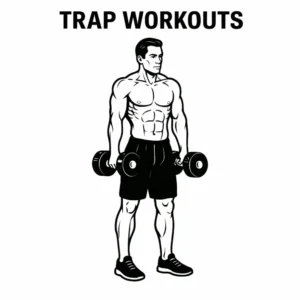
8 Best Trap Workouts
1. Barbell Shrugs
Barbell shrugs remain one of the most effective exercises for building upper trap size and strength.
Unlike many compound movements where the traps assist other muscles, shrugs place direct emphasis on shoulder elevation, making them one of the best isolation exercises for trap development.
Stand with your feet approximately shoulder-width apart while holding a barbell using an overhand grip. Allow your arms to remain fully extended and your shoulders relaxed.
Raise your shoulders straight upward toward your ears without bending your elbows or rolling your shoulders forward.
Pause briefly at the top before lowering the weight under complete control.
Focus on squeezing your traps rather than simply moving the weight.
2. Dumbbell Shrugs
Dumbbell shrugs provide many of the same benefits as barbell shrugs while allowing each shoulder to move independently.
This increased freedom of movement often results in a more natural range of motion and helps correct strength imbalances between the left and right sides.
Hold a dumbbell in each hand with your arms fully extended.
Raise both shoulders vertically before lowering the weights slowly.
Avoid using momentum or rotating your shoulders throughout the movement.
A controlled contraction will produce better results than simply lifting heavier weights.
3. Upright Rows
Upright rows are an excellent compound exercise that trains both the upper traps and the shoulders.
Using either a barbell, EZ curl bar, cable attachment, or dumbbells, pull the weight upward while keeping your elbows higher than your wrists.
Stop once the weight reaches approximately upper chest height before lowering it under control.
Proper technique is important during upright rows. Avoid lifting excessively high if it causes shoulder discomfort.
For many people, using dumbbells or cables creates a smoother movement pattern than a straight barbell.
4. Farmer’s Carry
Few exercises develop functional trap strength as effectively as the farmer’s carry.
Rather than lifting a weight repeatedly, this exercise requires you to carry heavy dumbbells or kettlebells while maintaining proper posture throughout the walk.
Stand tall while holding heavy weights at your sides.
Keep your shoulders pulled back, your chest lifted, and your core engaged as you walk forward with controlled steps.
Resist the urge to lean forward or shrug excessively.
This exercise strengthens the traps while simultaneously improving grip strength, core stability, posture, and overall conditioning.
5. Face Pulls
Although face pulls are commonly associated with shoulder health, they are also one of the best exercises for developing the middle and lower trapezius.
Attach a rope handle to a cable machine positioned at approximately upper chest height.
Pull the rope toward your face while allowing your hands to separate naturally.
Focus on squeezing your shoulder blades together before returning slowly to the starting position.
Face pulls help counteract rounded shoulders while improving posture and shoulder stability.
For individuals who spend long hours sitting at a desk, this exercise is particularly valuable.
6. Rack Pulls
Rack pulls allow you to overload the upper traps using heavier weights than most other exercises.
Because the movement begins with the bar elevated just below knee height, you can focus on the top portion of the deadlift where the traps work hardest.
Grip the bar securely before driving through your legs and hips until standing upright.
At the top of the movement, contract your traps without leaning backward.
Lower the bar slowly before repeating.
Rack pulls are an excellent choice for building overall upper-back thickness and improving deadlift performance.
7. Bent-Over Dumbbell Lateral Raises
Although commonly performed to target the rear deltoids, bent-over lateral raises also strengthen the middle and lower traps.
Begin by hinging forward at your hips while maintaining a flat back.
Holding a dumbbell in each hand, raise your arms outward until they reach shoulder height.
Pause briefly before lowering the weights under control.
Using lighter weights and maintaining strict form often produces better muscle activation than attempting heavier loads.
8. Power Shrugs
Power shrugs combine explosive hip extension with a strong shoulder shrug, making them highly effective for athletes looking to build explosive upper-body strength.
Begin with a barbell held at hip level.
Perform a slight knee bend before extending your hips forcefully and shrugging your shoulders upward.
Unlike traditional shrugs, power shrugs emphasize speed while still maintaining proper control.
Because this exercise uses heavier loads and explosive movement, it is generally best suited for intermediate and advanced lifters.
How Often Should You Train Your Traps?
The trapezius muscles recover relatively quickly compared to larger muscle groups, allowing most people to train them two or three times per week.
Rather than performing endless sets of shrugs, include a combination of isolation exercises and compound lifts that target all sections of the trapezius.
For example, combining shrugs with face pulls, rack pulls, and farmer’s carries creates a balanced routine that develops both strength and muscle size.
Allow at least one day of recovery between intense trap-focused workouts to support muscle growth and reduce fatigue.
Tips for Building Bigger Traps
Building impressive traps requires more than simply lifting heavy weights.
Focus on performing each repetition with a full range of motion while squeezing the traps at the top of every movement. Controlled repetitions generally produce greater muscle activation than rushing through sets.
Progressive overload remains one of the most important principles for muscle growth. Gradually increasing resistance, repetitions, or training volume over time encourages continued development.
Balancing trap training with shoulder mobility exercises also helps maintain healthy movement patterns while reducing muscle tightness.
Finally, remember that recovery is just as important as training. Consuming adequate protein, sleeping well, and allowing muscles time to recover all contribute to long-term growth.
Why Trap Training Matters
The trapezius is one of the largest muscles in the upper body, yet many people only associate it with the muscles that sit beside the neck. In reality, the traps extend across much of the upper back and are divided into three sections.
The upper traps elevate the shoulders and help support overhead movements. The middle traps pull the shoulder blades together, contributing to better posture and stronger rowing movements. The lower traps help stabilize the shoulder blades while supporting overhead pressing and shoulder health.
Because these muscles work together during many compound exercises, strengthening the traps improves far more than appearance. Well-developed traps contribute to better posture, increased upper-body stability, stronger deadlifts, improved shoulder mechanics, and greater overall athletic performance.
If your training program includes heavy pulling, pressing, or carrying movements, strong traps are essential for long-term progress and injury prevention.
Benefits of Strong Traps
Well-developed trapezius muscles offer several advantages beyond creating a thicker upper body.
One of the biggest benefits is improved posture. Strong traps help pull the shoulders back and stabilize the upper spine, making it easier to maintain proper alignment throughout the day.
Trap training also improves shoulder stability. Since the trapezius helps control shoulder blade movement, strengthening these muscles reduces unnecessary stress on the shoulder joint during pressing and pulling exercises.
Another important benefit is increased lifting performance. Exercises such as deadlifts, rows, pull-ups, and overhead presses all rely on strong traps for stability and force production.
Grip strength often improves as well because many trap-focused exercises require holding heavy weights for extended periods.
For athletes, stronger traps contribute to greater power during sprinting, throwing, wrestling, football, rugby, and many other sports that demand upper-body strength and stability.
Common Trap Training Mistakes
One of the most common mistakes is relying exclusively on shrugs.
Although shrugs are excellent for the upper traps, they do very little to strengthen the middle and lower fibers. Including rowing movements and face pulls creates more balanced development.
Another mistake is using excessive weight with poor technique. Swinging the body or using momentum reduces muscle activation and increases the risk of injury.
Many lifters also neglect posture during trap exercises. Keeping the chest lifted and core engaged helps maintain proper alignment throughout every repetition.
Finally, avoid rolling your shoulders during shrugs. Shoulder elevation should occur in a straight vertical line rather than a circular motion.
Final Thoughts
Developing bigger, stronger traps requires more than performing endless shrugs at the end of a workout. The trapezius is a large, complex muscle that benefits from a combination of heavy compound lifts, targeted isolation exercises, and functional movements that challenge strength, stability, and endurance.
Exercises such as barbell shrugs, farmer’s carries, face pulls, rack pulls, and upright rows each contribute to different aspects of trap development, helping you build a stronger upper back while improving posture, shoulder health, and overall athletic performance.
By training your traps consistently, focusing on proper technique, and gradually increasing the challenge over time, you’ll build a stronger, more balanced upper body that performs as well as it looks.
Last Updated on August 5, 2026
Written By

Join thousands of readers leveling up their fitness.
Skip the guesswork—get insights on training, health, and the right gear to support your progress.
You may also like
How To Do A Lat Pulldown Correctly
The lat pulldown is one of the best exercises for building a wider, stronger…
10 Different Types Of Deadlifts And Their Benefits
The deadlift is one of the most powerful compound exercises for building…

How to Strengthen Your Knees for Running
Strong, healthy knees are essential for runners, whether you’re logging miles…
Compound vs. Isolation Exercises: What’s the Difference?
When it comes to strength training, all exercises can generally be divided into…
Back Squat Exercise Guide: How to Master Back Squats
The back squat is one of the most effective strength training exercises for…
10 Medicine Ball Ab Exercises You Need To Try
If you’re tired of traditional crunches and planks, it’s time to add some…