

Named after bodybuilding legend Arnold Schwarzenegger, the Arnold Press is more than just a cool-looking shoulder move—it’s a powerhouse exercise that challenges your delts from multiple angles.
Unlike traditional shoulder presses, the Arnold Press includes a twisting motion, increasing the time under tension and hitting all three heads of the deltoid. Whether you’re aiming for aesthetics, strength, or performance, mastering this move can elevate your shoulder game.
What Is the Arnold Press?
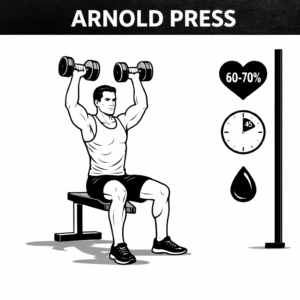
The Arnold Press is a variation of the standard dumbbell shoulder press. The key difference is the rotational motion: you start with the dumbbells in front of you (palms facing your body) and rotate them outward as you press upward.
Step-by-Step: How to Do the Arnold Press
- Start Position:
Sit on a bench with back support or stand tall. Hold a dumbbell in each hand, palms facing your shoulders (like a bicep curl). - Rotate and Press:
As you press the dumbbells upward, rotate your palms to face forward. - Top Position:
Finish with your arms fully extended overhead, biceps close to your ears. - Lower and Reverse:
Reverse the movement as you bring the dumbbells back to the starting position.
Reps: 3–4 sets of 8–12 reps for hypertrophy
Arnold Press Muscles Worked
The Arnold Press hits multiple upper-body muscles, offering a comprehensive shoulder challenge:
Primary Muscles:
- Anterior deltoid (front shoulder)
- Lateral deltoid (side shoulder)
- Posterior deltoid (rear shoulder)
Secondary Muscles:
- Triceps
- Upper trapezius
- Rotator cuff stabilizers
- Serratus anterior (to a lesser extent)
Because of the rotating motion, it engages more of the deltoid muscle fibers compared to a traditional press.
Benefits of the Arnold Press
Greater Range of Motion
The rotation increases time under tension and targets more muscle fibers.
Comprehensive Shoulder Activation
Unlike the standard dumbbell press, which primarily targets the front and middle delts, the Arnold Press also activates the rear delts.
Muscle Symmetry and Aesthetics
Build rounder, more balanced shoulders by hitting all three heads of the deltoid.
Mind-Muscle Connection
The slower, more controlled movement improves your focus and form.
Functional Strength and Stability
Helps build shoulder stability by involving smaller stabilizing muscles.
Seated vs. Standing Arnold Press
Seated Arnold Press:
- Offers more back support
- Better for isolating the shoulders
- Ideal for heavier weights
Standing Arnold Press:
- Engages core and balance
- More athletic, functional feel
- Slightly less stability for the shoulders
Choose seated for muscle growth, standing for functional training.
Common Mistakes to Avoid
Going Too Heavy
This compromises form and increases injury risk.
Fix: Use moderate weight and perfect your technique first.
Arching the Back
This strains your spine and takes focus off the shoulders.
Fix: Keep your core tight and glutes engaged to protect your lower back.
Rushing the Rotation
Speed kills form—and your gains.
Fix: Rotate slowly and deliberately to engage the right muscles.
Dropping Elbows Too Low
This removes tension from the delts.
Fix: Lower until dumbbells are at shoulder height, no lower.
Who Should Do the Arnold Press?
Bodybuilders: To target all parts of the deltoid for shoulder width and depth
Athletes: For improved shoulder stability and mobility
General Lifters: To add variety and intensity to upper-body workouts
Variations and Alternatives
- Dumbbell Shoulder Press: Simpler, good for building strength
- Barbell Overhead Press: More load, more core activation
- Z-Press: Performed seated on the floor for core-heavy overhead work
- Cable Shoulder Press: Constant tension throughout the movement
Safety Tips
- Always warm up your shoulders first (arm circles, band pull-aparts)
- Don’t lock out your elbows at the top
- Use controlled reps—don’t rush the rotation
- Stop if you feel pain in the shoulders or neck
FAQs About the Arnold Press
Is the Arnold Press better than the shoulder press?
It’s different, not necessarily better. The Arnold Press targets more muscle heads and adds variety, but may not allow as much weight as a strict shoulder press.
What size dumbbells should I use?
Start light (even 10–15 lbs) to master form. Increase as you get stronger.
Can beginners do the Arnold Press?
Yes—but start with seated dumbbell presses if stability is an issue.
Should I include the Arnold Press in every shoulder workout?
Once per week is plenty if you’re doing other shoulder movements.
Conclusion:
The Arnold Press is a dynamic, effective variation of the shoulder press that can help you build balanced, 3D delts. With its unique rotation and full range of motion, it challenges your shoulders in ways that few other exercises do.
Add it into your shoulder day for variety, intensity, and real results—and remember: form first, then weight.
Written By

Join thousands of readers leveling up their fitness.
Skip the guesswork—get insights on training, health, and the right gear to support your progress.
You may also like
How to Do Hip Thrusts the Right Way
Looking to grow stronger, rounder glutes? The hip thrust is one of the most…

How To Do Squats Properly
The squat is often called the king of exercises—and for good reason. It targets…

8 Best Shoulder Mobility Exercises
Stiff shoulders? Limited range of motion? You're not alone. Shoulder mobility…

Why Workout Splits Could Be the Secret to Building Muscle
Ever feel like you're working out hard but not seeing the muscle growth you…

What Is Zone 2 Cardio and How to Do It
You may have heard athletes, trainers, or fitness influencers talking about…
8 Effective Landmine Row Exercises for a Stronger Back
Want a stronger, more sculpted back? Landmine rows might be the missing piece…