

Building a strong back takes more than simply performing rows with heavier weights. The quality of your movement, the angle of the exercise, and the muscles you target all influence your results. If you’re looking for an exercise that develops back thickness, improves pulling strength, and places less stress on your lower back than traditional bent-over rows, the landmine row is an excellent choice.
The landmine row has become increasingly popular among strength coaches, athletes, and recreational lifters because it combines stability with natural movement. The angled path of the bar allows many people to train their back more comfortably while still lifting challenging loads. It is also a highly versatile exercise, offering several variations that can be adjusted to match different fitness levels and training goals.
Whether you want to build a wider back, improve posture, increase pulling power, or add variety to your workouts, landmine rows deserve a place in your routine.
In this guide, you’ll learn what the landmine row is, which muscles it targets, how to perform it correctly, and eight effective variations that can help you build a stronger, more muscular back.
What Is a Landmine Row?
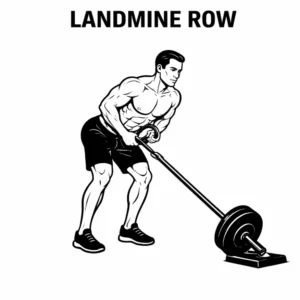
A landmine row is a compound pulling exercise performed using a barbell anchored at one end inside a landmine attachment or securely positioned in a corner. Because the bar moves along a fixed arc rather than a completely vertical or horizontal path, the exercise creates a unique pulling angle that feels more natural for many lifters.
Unlike traditional bent-over rows, the landmine row allows you to maintain a more comfortable torso position while still placing significant tension on the muscles of the back. This makes it an excellent option for people who experience discomfort during conventional barbell rows or those looking for additional exercise variety.
Landmine rows can be performed using both arms simultaneously or one arm at a time, making them suitable for building overall strength while correcting muscular imbalances.
How to Perform a Standard Landmine Row
Before exploring different variations, it’s important to master the basic movement.
Anchor one end of a barbell securely inside a landmine attachment or against a stable corner. Load the opposite end with an appropriate amount of weight.
Stand facing the loaded end of the bar with your feet approximately shoulder-width apart.
Push your hips backward while maintaining a flat back and slightly bent knees.
Grip the end of the bar using both hands or a close-grip attachment.
Pull the weight toward the lower portion of your chest while driving your elbows backward.
Pause briefly while squeezing your shoulder blades together before lowering the weight slowly under control.
Throughout the movement, keep your torso stable and avoid using momentum to lift the weight.
1. Single-Arm Landmine Row
The single-arm landmine row is one of the best variations for improving unilateral strength and correcting muscle imbalances.
Instead of using both hands, grip the end of the bar with one hand while positioning your body beside the barbell.
Pull the weight toward your waist while keeping your torso stable and resisting rotation.
Because your core works harder to maintain balance, this variation strengthens both the back and abdominal muscles simultaneously.
It is an excellent choice for athletes and anyone looking to improve coordination alongside strength.
2. Meadows Row
Named after legendary bodybuilder John Meadows, the Meadows row is a favorite among experienced lifters seeking greater upper-back development.
Stand perpendicular to the barbell and reach behind your body to grip the loaded end using an overhand grip.
As you row the weight upward, allow your elbow to travel slightly away from your torso.
This movement shifts greater emphasis toward the upper lats, rear delts, and rhomboids while creating an intense contraction throughout the upper back.
Because of its unique positioning, the Meadows row is particularly effective for increasing back thickness.
3. Bent-Over Landmine Row
The bent-over landmine row closely resembles a traditional T-bar row while maintaining the benefits of the landmine setup.
Using both hands, grip the end of the bar with a close-grip attachment or by interlocking your fingers around the sleeve.
Maintain a strong hip hinge before rowing the weight toward your torso.
This variation allows heavier loading than many single-arm exercises, making it ideal for building overall back mass and pulling strength.
4. Chest-Supported Landmine Row
The chest-supported variation minimizes lower-back involvement by placing your torso against an incline bench.
Supporting your body removes much of the momentum commonly seen during rowing exercises, allowing your back muscles to perform more of the work.
Because spinal loading is reduced, this variation works well for people recovering from lower-back fatigue or those who want to isolate the upper back more effectively.
Focus on slow, controlled repetitions while squeezing your shoulder blades together during every lift.
5. Landmine T-Bar Row
The landmine T-bar row is one of the best exercises for building back thickness.
Using a close-grip handle attached beneath the loaded end of the bar, perform the row while maintaining a stable hip hinge.
This setup allows heavier weights than many other landmine variations while maintaining a comfortable pulling angle.
The movement strongly targets the lats, rhomboids, traps, and rear deltoids, making it a valuable addition to hypertrophy-focused training programs.
6. Split-Stance Landmine Row
The split-stance variation introduces an additional balance challenge while improving unilateral stability.
Begin with one foot positioned slightly in front of the other.
Grip the bar using one hand before performing the rowing movement without allowing your torso to rotate.
Because the staggered stance forces your core to work harder, this variation improves athletic performance while strengthening the muscles responsible for stability and balance.
7. Deficit Landmine Row
Standing on a small platform or weight plate increases the range of motion during each repetition.
The additional movement allows your lats and upper back muscles to stretch further at the bottom of the exercise before contracting fully at the top.
This increased range often leads to greater muscle activation while improving mobility and flexibility throughout the movement.
Only use this variation if your flexibility allows you to maintain a neutral spine throughout the exercise.
8. Banded Landmine Row
Adding resistance bands changes the strength curve by increasing tension as the bar approaches the top of the movement.
This additional resistance challenges the muscles during the strongest portion of the lift while encouraging explosive pulling power.
The banded variation is commonly used by athletes seeking greater power development and experienced lifters looking to overcome strength plateaus.
What Muscles Does the Landmine Row Work?
The landmine row primarily targets the muscles responsible for pulling and stabilizing the upper body.
The latissimus dorsi performs most of the pulling movement, helping create a wider and stronger back. The rhomboids and middle trapezius work together to retract the shoulder blades, improving posture and upper-back strength.
The rear deltoids assist throughout the exercise by helping stabilize the shoulders, while the biceps contribute during elbow flexion.
The exercise also challenges the forearms and grip because you must maintain control of the weight throughout every repetition.
In addition, your abdominal muscles, obliques, glutes, and lower back remain active to stabilize your body and maintain proper posture during the movement.
Because so many muscles work together, the landmine row is considered one of the most effective compound exercises for total upper-body development.
Common Landmine Row Mistakes
Many lifters reduce the effectiveness of landmine rows by making avoidable technique errors.
One of the most common mistakes is rounding the lower back. Maintaining a neutral spine throughout the movement helps protect the lower back while improving force production.
Another mistake is relying on momentum instead of muscular control. Swinging the torso or jerking the weight upward reduces muscle activation and increases injury risk.
Some lifters also pull with their arms rather than driving their elbows backward. Focusing on elbow movement helps shift more of the workload onto the back muscles.
Using excessive weight before mastering proper technique is another common issue that often limits long-term progress.
Landmine Row Alternatives
If you don’t have access to a landmine attachment, several exercises provide similar training benefits.
Traditional barbell rows develop overall back strength but require greater lower-back stability.
Single-arm dumbbell rows are excellent for correcting muscular imbalances while improving unilateral strength.
Cable rows provide constant tension throughout every repetition and are often easier for beginners to learn.
T-bar rows closely resemble the landmine row and remain one of the best options for building upper-back thickness.
Including a variety of rowing movements throughout your training program helps stimulate balanced muscle development while preventing plateaus.
Final Thoughts
The landmine row is one of the most versatile and effective exercises for developing a stronger, thicker back. Its unique pulling angle allows you to train multiple upper-body muscles while placing less stress on the lower back than many traditional rowing variations.
Whether you choose the standard landmine row, Meadows row, chest-supported version, or one of the other variations covered in this guide, consistent training with proper technique will help improve posture, increase pulling strength, and build a more balanced physique.
Rather than relying on a single variation, rotate different landmine row exercises throughout your training program to challenge your muscles from multiple angles and continue making progress over time. With patience, consistency, and proper form, the landmine row can become one of the most valuable exercises in your back workout.
Last Updated on August 5, 2026
Written By

Join thousands of readers leveling up their fitness.
Skip the guesswork—get insights on training, health, and the right gear to support your progress.
You may also like

How To Do A Lat Pulldown Correctly
The lat pulldown is one of the best exercises for building a wider, stronger…
10 Different Types Of Deadlifts And Their Benefits
The deadlift is one of the most powerful compound exercises for building…

How to Strengthen Your Knees for Running
Strong, healthy knees are essential for runners, whether you’re logging miles…

Compound vs. Isolation Exercises: What’s the Difference?
When it comes to strength training, all exercises can generally be divided into…
Back Squat Exercise Guide: How to Master Back Squats
The back squat is one of the most effective strength training exercises for…

10 Medicine Ball Ab Exercises You Need To Try
If you’re tired of traditional crunches and planks, it’s time to add some…