

A strong, wide back doesn’t just look impressive — it supports better posture, pulling power, and overall athletic performance. Your latissimus dorsi, or “lats,” are the broad muscles that give your back that V-shaped appearance. Training them effectively helps build width and definition, making your upper body look stronger and more balanced.
Below are some of the best lat exercises you can add to your workout routine to develop a bigger, wider back.
1. Pull-Ups
The classic pull-up is one of the most effective exercises for building your lats.
How to do it:
Grab a pull-up bar with an overhand grip slightly wider than shoulder-width. Engage your core and pull your body upward until your chin passes the bar. Lower yourself with control.
Pro Tip:
Use different grips — wide, neutral, or underhand — to target different parts of your lats.
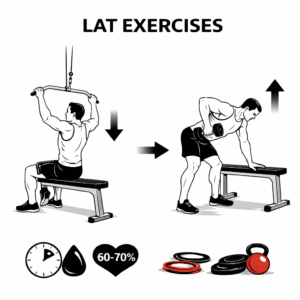
2. Lat Pulldown
A great machine-based movement that mimics the pull-up and allows for adjustable resistance.
How to do it:
Sit on the lat pulldown machine, grip the bar wider than your shoulders, and pull it down to your upper chest. Keep your back straight and focus on squeezing your shoulder blades together.
Pro Tip:
Avoid using momentum. Keep your movement slow and controlled for maximum engagement.
3. Barbell Row
One of the best compound lifts for overall back development and lat thickness.
How to do it:
Hold a barbell with an overhand grip, bend forward at the hips, and keep your back flat. Pull the bar toward your lower ribcage, then slowly lower it back down.
Pro Tip:
Don’t let your torso move up and down during the lift — stay solid and drive through your elbows.
4. Dumbbell Row
A versatile exercise that allows for a full stretch and contraction of each lat individually.
How to do it:
Place one hand and knee on a bench, hold a dumbbell with the opposite hand, and pull it toward your hip. Lower it back down with control.
Pro Tip:
Avoid twisting your torso — keep your chest facing down and focus on the lat doing the work.
5. Seated Cable Row
This movement targets the mid-back and helps improve overall pulling strength.
How to do it:
Sit on the machine with your feet braced. Grab the handles, keep your back straight, and pull toward your abdomen. Squeeze your shoulder blades together before returning to the starting position.
Pro Tip:
Try different attachments — wide grip, close grip, or rope — to hit your lats from different angles.
6. Straight-Arm Pulldown
An isolation exercise that emphasizes lat stretch and control.
How to do it:
Stand in front of a cable machine with a straight bar attached. With arms extended, pull the bar down toward your thighs while keeping your elbows locked. Return slowly to the starting position.
Pro Tip:
Focus on keeping constant tension on your lats throughout the movement.
7. Chest-Supported Row
This variation removes lower-back strain while allowing you to focus entirely on your lats and upper back.
How to do it:
Lie chest-down on an incline bench, holding dumbbells or a barbell. Pull the weights toward your body, squeezing your shoulder blades together at the top.
Pro Tip:
Keep your chin tucked and avoid shrugging your shoulders.
8. Single-Arm Lat Pulldown
A great unilateral exercise that improves symmetry and lat activation.
How to do it:
Using a single-handle cable attachment, pull one arm down toward your side while keeping your torso stable. Focus on a full stretch at the top and a strong contraction at the bottom.
Pro Tip:
Use lighter weights to maintain form and feel the muscle work.
9. Inverted Row
A bodyweight alternative that’s perfect for home or gym setups.
How to do it:
Set a bar at waist height, lie underneath, and grab it with an overhand grip. Keep your body straight and pull your chest up toward the bar. Lower yourself slowly.
Pro Tip:
Adjust the bar height — lower makes it harder, higher makes it easier.
10. Deadlift
While not an isolation exercise, the deadlift develops total posterior-chain strength, including the lats.
How to do it:
With feet hip-width apart, grip the bar just outside your knees. Keep your chest up and back flat as you lift the bar from the ground by driving through your legs and hips.
Pro Tip:
Focus on form and controlled movement rather than maximum weight.
Final Thoughts
A well-developed back isn’t just about strength; it’s about balance, posture, and power. Incorporate a mix of compound lifts and isolation movements to train your lats from all angles. Be consistent, use proper form, and progressively increase your load to see long-term growth.
Written By

Join thousands of readers leveling up their fitness.
Skip the guesswork—get insights on training, health, and the right gear to support your progress.
You may also like

How To Do A Lat Pulldown Correctly
The lat pulldown is one of the best exercises for building a wider, stronger…

10 Different Types Of Deadlifts And Their Benefits
The deadlift is one of the most powerful compound exercises for building…

How to Strengthen Your Knees for Running
Strong, healthy knees are essential for runners, whether you’re logging miles…

Compound vs. Isolation Exercises: What’s the Difference?
When it comes to strength training, all exercises can generally be divided into…

Back Squat Exercise Guide: How to Master Back Squats
The back squat is one of the most effective strength training exercises for…

10 Medicine Ball Ab Exercises You Need To Try
If you’re tired of traditional crunches and planks, it’s time to add some…