

Strong legs are not built by training the muscles you can see from the front and ignoring everything behind them. The hamstrings play a major role in lower-body strength, athletic performance, balance, and everyday movement, yet they are often overlooked in favor of exercises that primarily target the quadriceps.
Located along the back of the thighs, the hamstrings are involved whenever you bend your knee or extend your hip. They help you walk, run, jump, accelerate, slow down, and maintain control when your body changes direction. They also work alongside the glutes and other muscles around the hips and knees to keep your lower body stable.
That makes hamstring training important whether your goal is building muscle, getting stronger, improving athletic performance, or simply developing more balanced legs.
The good news is that you do not need an extremely complicated program to train them effectively. A combination of hip-hinge exercises, knee-flexion movements, single-leg exercises, and well-chosen accessory movements can provide a thorough hamstring workout.
You can perform many of these exercises in a commercial gym using barbells, dumbbells, machines, cables, and other equipment. Others can be adapted for a home gym with relatively little equipment.
The key is learning how each movement trains the hamstrings and understanding how to perform it with control.
In this guide, we will cover 10 effective hamstring exercises, including gym-based movements and options that can be adapted for home training. You will also learn how to combine them into a balanced lower-body routine and how to progress as your strength improves.
Why Train Your Hamstrings?
The hamstrings are more than an aesthetic muscle group. They are involved in some of the most important movements your lower body performs.
Whenever you extend your hips, the hamstrings work alongside the glutes to help move your body. When you bend your knees, they contribute to bringing your lower leg toward your body. During running and other athletic activities, they also help control the movement of your legs as they swing and prepare to contact the ground.
This combination of functions means that effective hamstring training should not rely on just one type of exercise.
A leg curl, for example, trains the hamstrings primarily through knee flexion. A Romanian deadlift challenges them through hip extension while they are lengthened under load. Including both types of movements can give you a more complete approach to hamstring development.
Strong hamstrings can also contribute to better overall lower-body balance. If your training heavily favors the quadriceps while giving little attention to the muscles on the back of your legs, your program may not be as well rounded as it could be.
For athletes, hamstring strength is particularly relevant because sprinting, jumping, cutting, and other explosive activities place substantial demands on the posterior chain.
For general fitness, the benefit is simpler. Stronger hamstrings help you move with confidence and give you a stronger foundation for other lower-body exercises.
Best Hamstring Exercises
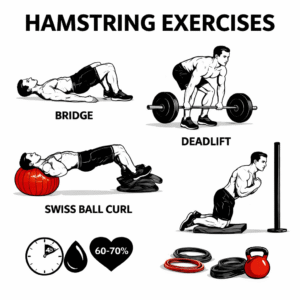
1. Romanian Deadlift
The Romanian deadlift, commonly called the RDL, is one of the most useful hamstring exercises you can add to a strength-training program.
Unlike a conventional deadlift, where the weight begins on the floor, the Romanian deadlift generally starts from a standing position. The movement focuses on pushing the hips backward while maintaining a slight bend in the knees.
This creates significant tension through the hamstrings as they lengthen under resistance.
The RDL also trains the glutes and requires your lower back and core to stabilize your torso. That makes it an excellent compound exercise for developing the posterior chain.
How to Do a Romanian Deadlift
Stand with your feet approximately hip-width apart while holding a barbell or dumbbells in front of your thighs.
Keep your knees slightly bent and brace your core. From there, push your hips backward while allowing your torso to lean forward naturally.
Keep the weights close to your legs as they travel downward.
Lower the resistance only as far as you can while maintaining control and a stable spine. You should feel a strong stretch through the hamstrings, but you do not need to force the weights all the way to the floor.
Once you reach the bottom of your comfortable range, drive your hips forward and return to standing.
The movement should come primarily from the hips rather than from bending your knees excessively.
2. Leg Curl Machine
If the Romanian deadlift trains the hamstrings through hip extension, the leg curl provides a different challenge by focusing primarily on knee flexion.
This makes the leg curl a valuable complement to compound exercises.
The machine version is particularly useful because it provides external support and allows you to focus directly on bending the knees against resistance.
Depending on the equipment available, you may encounter seated, lying, or standing leg curl machines.
How to Do a Leg Curl
Adjust the machine so that your knees line up appropriately with the machine’s pivot point and the padded lever rests comfortably against the lower part of your legs.
Secure yourself according to the machine’s instructions.
From the starting position, curl your heels toward your glutes while keeping your body firmly supported.
Squeeze the hamstrings at the end of the movement, then slowly return the resistance to the starting position.
Do not allow the weight stack to crash down between repetitions.
3. Glute-Ham Raise
The glute-ham raise is a demanding bodyweight or weighted exercise that challenges the hamstrings while also involving the glutes and muscles responsible for stabilizing your torso.
It is often performed using a glute-ham developer, commonly called a GHD.
The exercise requires significant control because your hamstrings must help manage your body as you lower your torso and then return to the starting position.
How to Perform a Glute-Ham Raise
Secure your feet beneath the machine’s footplate and position your body comfortably against the pads.
Start with your torso upright.
Slowly lower your upper body forward while maintaining control through your hips and core.
Once you reach a position you can control, use your hamstrings and glutes to bring your body back toward the starting position.
The movement should not feel like you are simply folding at the hips.
4. Kettlebell Swing
The kettlebell swing is different from most traditional hamstring exercises because it is performed explosively.
Rather than slowly lifting the kettlebell with your arms, the movement is driven by a powerful hip extension.
This makes it an effective exercise for developing power through the glutes and hamstrings while also challenging your cardiovascular system.
How to Do a Kettlebell Swing
Stand with your feet approximately shoulder-width apart and hold the kettlebell with both hands.
Begin by pushing your hips backward while keeping a slight bend in your knees. Allow the kettlebell to travel between your legs while maintaining a stable torso.
From this loaded position, drive your hips forward explosively.
The force generated by your hips should cause the kettlebell to swing upward.
The arms guide the kettlebell, but they should not be responsible for lifting it to chest height.
Allow the kettlebell to return naturally between your legs before repeating the movement.
5. Single-Leg Deadlift
Single-leg deadlifts combine hamstring and glute training with balance and coordination.
Unlike bilateral exercises where both legs share the load, a single-leg deadlift requires one side of your body to control the movement.
This can make the exercise particularly useful for identifying differences in strength, balance, and coordination between your legs.
How to Perform a Single-Leg Deadlift
Stand tall with your feet together and hold a dumbbell in one hand.
Shift your weight onto one leg.
Keeping a slight bend in the standing knee, push your hips backward while extending the opposite leg behind you.
Lower the dumbbell toward the floor as your torso moves forward.
Continue only as far as you can maintain balance and control.
Then drive your hips forward and return to standing.
6. Good Morning
The good morning is another hip-hinge exercise that trains the hamstrings and glutes while requiring your lower back and core to stabilize the torso.
It is an effective exercise, but it also requires more technical awareness than some beginner-friendly hamstring movements.
For that reason, it is best to start with very light resistance.
How to Do a Good Morning
Position a light barbell across your upper back.
Stand with your feet in a comfortable stance and maintain a slight bend in your knees.
Brace your core and push your hips backward.
As your hips move behind you, your torso will naturally lean forward.
Continue until you reach a range of motion that you can control while maintaining a neutral spine.
Then drive your hips forward to return to standing.
7. Swiss Ball Hamstring Curl
The Swiss ball hamstring curl is an excellent option when you want to train your hamstrings without using a machine.
It also adds a stability challenge because your body needs to maintain control while the ball moves underneath your legs.
This makes the exercise useful for home gym hamstring workouts.
How to Do a Swiss Ball Hamstring Curl
Lie on your back and place your heels on top of a stability ball.
Lift your hips from the floor so your body forms a relatively straight line from your shoulders toward your knees.
From this position, bend your knees and pull the ball toward your body.
Keep your hips elevated as you bring the ball closer.
Once your knees are bent, slowly extend your legs and allow the ball to move away from you.
Lower your hips only after completing the movement if necessary.
8. Cable Pull-Through
The cable pull-through is a useful exercise for learning and reinforcing the hip-hinge pattern.
Because the cable provides resistance from behind, you need to control the movement as you allow your hips to travel backward and then drive them forward.
It primarily trains the glutes and hamstrings and can be a useful alternative to heavier deadlift variations.
How to Do a Cable Pull-Through
Attach a rope handle to a low cable pulley.
Stand facing away from the machine and hold the rope between your legs.
Walk forward far enough to create tension in the cable.
From there, push your hips backward while keeping your torso controlled.
Once you reach the end of your comfortable range, drive your hips forward and return to standing.
Finish with a controlled hip extension and contract your glutes.
9. Nordic Hamstring Curl
The Nordic hamstring curl is one of the most demanding bodyweight exercises for the hamstrings.
It places a significant challenge on the muscles as they control the descent of your body, making it particularly useful for developing eccentric hamstring strength.
However, it is not a beginner exercise for most people.
How to Perform a Nordic Curl
Kneel on a padded surface and secure your ankles underneath a stable support or have a suitable training partner hold them firmly.
Keep your body relatively straight from your knees through your hips and torso.
Slowly lower your upper body toward the floor.
The goal is to resist the descent with your hamstrings rather than simply falling forward.
Once you reach the point where you can no longer control the movement, use your hands to assist yourself back to the starting position if necessary.
10. Walking Lunges
Walking lunges are not a hamstring isolation exercise, but they are an excellent lower-body movement that trains the hamstrings alongside the glutes and quadriceps.
They also require balance, coordination, and control from one leg to the next.
That makes them a useful addition to a well-rounded glute and hamstring workout.
How to Do Walking Lunges
Stand tall with your feet approximately hip-width apart.
Take a controlled step forward with one leg.
Lower your body by bending both knees until you reach a comfortable lunge position.
Your front foot should remain stable while your back knee moves toward the floor.
Drive through your front foot and bring your rear leg forward into the next step.
Continue alternating legs as you move forward.
How to Build a Hamstring Workout
You do not need to perform all 10 exercises in one session.
Doing so would create a large amount of unnecessary volume and make it difficult to maintain quality throughout the workout.
A better approach is to select two or three hamstring exercises that train the muscles in different ways.
For example, you could combine the Romanian deadlift with a leg curl and walking lunges.
The Romanian deadlift provides a loaded hip-hinge movement, the leg curl directly trains knee flexion, and the walking lunges add unilateral lower-body work.
Another workout could combine a cable pull-through, Swiss ball hamstring curl, and kettlebell swing.
This gives you a combination of controlled strength work and more dynamic hip-extension training.
The specific combination should depend on your experience, available equipment, and the rest of your lower-body program.
How Many Hamstring Exercises Should You Do?
For most people, two or three hamstring-focused exercises in a lower-body workout are enough.
The original article recommends including two to three hamstring exercises in lower-body workouts each week.
That does not mean you need to perform two or three exercises every single day.
Your hamstrings are also involved in other lower-body movements such as deadlifts, lunges, squats, and certain forms of running and jumping.
Your total training volume therefore matters.
If you perform Romanian deadlifts, leg curls, and Nordic curls in the same workout, for example, you are already placing a substantial demand on the hamstrings.
More exercises are not automatically better.
Choose movements that complement each other and allow you to recover before the next demanding session.
How to Progress Your Hamstring Training
Progressive overload is an important part of building stronger hamstrings.
Once an exercise becomes consistently manageable, you need to provide a new challenge.
With a Romanian deadlift, that may mean gradually increasing the weight.
With a leg curl, you may increase the resistance or perform additional controlled repetitions.
With a Nordic curl, progression may come from increasing the amount of the movement you can control rather than simply adding weight.
You can also progress exercises by improving technique, increasing range of motion, adding repetitions, or slowing the eccentric portion of the movement.
There is no need to increase every variable simultaneously.
Small, consistent improvements add up.
How to Warm Up Before Hamstring Training
A good warm-up should prepare your body without exhausting it.
Begin with several minutes of light activity to increase your body temperature. Walking, cycling, or another easy cardiovascular activity can work well.
Follow that with movement specific to your workout.
If Romanian deadlifts are your first major exercise, perform several unloaded hip hinges before picking up your working weight.
You can also perform a few light warm-up sets with the actual exercise.
For exercises such as Nordic curls, which are particularly demanding, spend additional time preparing the hamstrings and knees before attempting difficult repetitions.
The goal is to feel ready to train, not tired before the workout begins.
Common Hamstring Training Mistakes
One of the biggest mistakes is trying to train the hamstrings with heavy resistance before learning how to control the movement.
This is particularly relevant to Romanian deadlifts and good mornings. Both exercises require you to maintain control while your hips move backward and your hamstrings lengthen under load.
Another mistake is relying exclusively on isolation exercises.
Leg curls have an important place in a hamstring program, but compound movements such as RDLs and lunges provide additional benefits and train the muscles in different ways.
Training only one side of the body can also create problems. Single-leg exercises provide a useful way to develop unilateral strength and identify differences between your legs.
Finally, do not ignore recovery.
Hard hamstring sessions can leave your posterior chain fatigued for several days, especially when they include eccentric movements such as Nordic curls.
Give your body enough time to recover before repeating high-intensity hamstring work.
Final Thoughts
Strong hamstrings are an important part of a well-developed lower body.
They help you extend your hips, bend your knees, run, jump, change direction, and maintain control during everyday movement. Training them properly can also improve the balance of your lower-body program and provide a stronger foundation for other exercises.
The most effective approach is not to find one magical hamstring exercise and perform it endlessly.
Instead, build your training around a combination of movements.
Use exercises such as Romanian deadlifts to train the hamstrings through a loaded hip hinge. Include leg curls when you want direct knee-flexion work. Add single-leg exercises to challenge balance and unilateral strength. More advanced movements such as Nordic curls can provide an additional challenge once you have developed the necessary strength and control.
Your equipment does not have to determine whether your hamstring workout is effective. A commercial gym gives you more options, but a well-designed home gym hamstring workout can still provide plenty of resistance and variety.
Start with exercises you can perform confidently. Learn the movement before adding significant weight. Increase the challenge gradually as your strength improves, and give your muscles enough time to recover between demanding sessions.
Most importantly, train your hamstrings as part of your entire lower body rather than treating them as an afterthought.
Strong quads, glutes, hamstrings, and calves work together. When you develop them as a balanced system, you are not only building stronger-looking legs. You are building a lower body that is better prepared for training, sport, and everyday movement.
Consistency will always matter more than chasing the most complicated workout.
Choose a few effective exercises, perform them well, progress gradually, and give your body time to adapt. That is the foundation of effective hamstring training.
Last Updated on September 3, 2026
Written By

Join thousands of readers leveling up their fitness.
Skip the guesswork—get insights on training, health, and the right gear to support your progress.
You may also like
How To Do A Lat Pulldown Correctly
The lat pulldown is one of the best exercises for building a wider, stronger…
10 Different Types Of Deadlifts And Their Benefits
The deadlift is one of the most powerful compound exercises for building…
How to Strengthen Your Knees for Running
Strong, healthy knees are essential for runners, whether you’re logging miles…
Compound vs. Isolation Exercises: What’s the Difference?
When it comes to strength training, all exercises can generally be divided into…
Back Squat Exercise Guide: How to Master Back Squats
The back squat is one of the most effective strength training exercises for…
10 Medicine Ball Ab Exercises You Need To Try
If you’re tired of traditional crunches and planks, it’s time to add some…