

If you want to build explosive back strength and improve your pulling power, the Pendlay Row is one of the best barbell exercises to include in your program. Unlike traditional rows, this lift starts from a dead stop on the floor, forcing your muscles to generate maximum force with every rep — resulting in stronger, cleaner lifts overall.
What is the Pendlay Row?
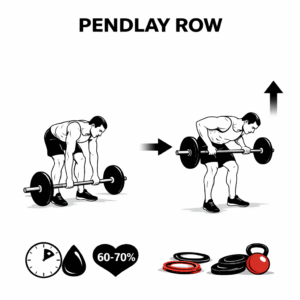
The Pendlay Row is a strength-training movement named after Olympic weightlifting coach Glenn Pendlay. It’s a variation of the barbell row, but instead of keeping constant tension throughout, the barbell returns to the floor after each repetition.
This dead-stop technique emphasizes explosive pulling strength, building your back, traps, lats, and posterior chain, while improving power transfer for big lifts like the deadlift and clean.
Pendlay Row vs. Barbell Row
While both movements target similar muscle groups, their execution and benefits differ:
| Exercise | Starting Position | Tempo | Primary Benefit |
| Pendlay Row | Bar starts on the floor | Explosive | Builds power and strength |
| Barbell Row | Bar hovers above the ground | Controlled | Builds endurance and tension |
The Pendlay Row focuses on power production, while the Barbell Row emphasizes muscle control and time under tension.
Muscles Worked
The Pendlay Row targets a wide range of upper and lower posterior muscles, including:
- Lats – for pulling strength
- Trapezius – for posture and back width
- Rhomboids – for scapular retraction
- Posterior deltoids – for upper-back stability
- Erector spinae and hamstrings – for core and lower back support
How to Perform the Pendlay Row (Step-by-Step)
1. Setup
- Stand with your feet shoulder-width apart.
- Position the barbell over your midfoot.
- Bend at your hips and knees until your torso is almost parallel to the ground.
- Grip the bar slightly wider than shoulder-width with an overhand grip.
2. Brace Your Core
- Keep your back flat, spine neutral, and core engaged.
- Your eyes should look a few feet ahead, not straight down.
3. Pull Explosively
- Drive your elbows up and back, pulling the barbell toward your lower chest or upper abs.
- Squeeze your shoulder blades together at the top.
4. Return to the Floor
- Lower the barbell under control until it rests on the ground.
- Reset your position before each rep.
5. Repeat
- Perform 6–10 reps per set, focusing on power and form.
Common Mistakes to Avoid
- Rounding your back: Keep your spine neutral to avoid injury.
- Using momentum: Reset each rep from a dead stop; avoid swinging.
- Lifting your chest early: Maintain torso position parallel to the ground.
- Going too heavy: Prioritize form before adding weight.
Benefits of the Pendlay Row
- Builds explosive pulling power
- Strengthens upper and lower back muscles
- Improves deadlift and clean performance
- Enhances posture and shoulder stability
- Encourages strict technique and full range of motion
Pro Tips for Better Results
- Perform the Pendlay Row at the start of your back workout while you’re fresh.
- Use bumper plates if available — they allow consistent height and safe resets.
- Combine with deadlifts, pull-ups, and face pulls for a complete posterior chain workout.
- Focus on speed and precision, not just heavyweight.
Final Thoughts
The Pendlay Row is a powerful lift for athletes, bodybuilders, and anyone aiming to build a stronger, more explosive back. Its strict form and dead-stop mechanics make it a true test of power and control. Master the technique, keep your movements clean, and you’ll see a noticeable difference in your pulling strength and overall performance.
Written By

Join thousands of readers leveling up their fitness.
Skip the guesswork—get insights on training, health, and the right gear to support your progress.
You may also like

How To Do A Lat Pulldown Correctly
The lat pulldown is one of the best exercises for building a wider, stronger…

10 Different Types Of Deadlifts And Their Benefits
The deadlift is one of the most powerful compound exercises for building…

How to Strengthen Your Knees for Running
Strong, healthy knees are essential for runners, whether you’re logging miles…

Compound vs. Isolation Exercises: What’s the Difference?
When it comes to strength training, all exercises can generally be divided into…
Back Squat Exercise Guide: How to Master Back Squats
The back squat is one of the most effective strength training exercises for…

10 Medicine Ball Ab Exercises You Need To Try
If you’re tired of traditional crunches and planks, it’s time to add some…