

Strength gives you the ability to produce force. Plyometric training teaches you to produce that force quickly.
That difference matters.
An athlete can be strong in the weight room and still lack the explosiveness needed to sprint, jump, change direction, or react quickly. Plyometric exercises help bridge that gap by training the body to produce powerful movements in a short amount of time.
Plyometrics, sometimes called jump training, involves fast and explosive movements such as jumping, bounding, hopping, and throwing. The exercises can challenge the muscles while also requiring coordination, balance, timing, and control.
That combination is what makes plyometric training useful for athletes and active people who want to become more explosive.
You do not need to be a professional athlete to benefit from this type of training. However, plyometric exercises are more demanding than standard bodyweight movements, so they should be introduced at an appropriate level.
Someone new to explosive training may benefit from simple jump variations with controlled landings. A more experienced athlete may be ready for exercises such as depth jumps, bounding, or more advanced reactive drills.
The goal is not to perform as many repetitions as possible.
Plyometrics are about quality.
A powerful jump performed with good mechanics is more valuable than repeatedly jumping while exhausted and losing control of your landing.
This guide covers 10 of the best plyometric exercises for developing speed, power, explosiveness, coordination, and jumping ability. It also explains how each movement works, what to focus on, and how to approach plyometric training safely and progressively.
Why Plyometric Training Matters
Plyometric training is designed around explosive movement.
When you jump, bound, or perform another fast movement, your body has to coordinate multiple muscles in a very short period. The ability to generate force quickly is often referred to as power.
This is different from simply being strong.
For example, a heavy squat can help you develop lower-body strength, but jumping requires you to take that strength and express it rapidly.
Plyometric exercises give you an opportunity to practice that faster expression of force.
They can also challenge your ability to absorb force.
Every jump has two parts. You have to produce force to leave the ground, but you also have to control your body when you come back down.
That is why landing mechanics are just as important as jumping height.
A good plyometric program can therefore involve much more than simply trying to jump as high as possible. It can include horizontal jumps for forward power, lateral movements for side-to-side explosiveness, single-leg drills for stability, and upper-body exercises such as plyometric push-ups.
The original article identifies explosive strength, speed, jump height, coordination, reaction time, and athletic performance as the primary reasons for using plyometric training.
These qualities overlap, but the exercise you choose should still match your specific goal.
How to Start Plyometric Training
Plyometric exercises place more demand on your muscles and joints than many conventional strength exercises.
That does not mean they are inherently unsafe. It means they should be approached with the same attention to technique and progression you would use with other demanding exercises.
If you are new to plyometrics, start with simpler movements.
You might begin with controlled jump squats, low box jumps, or basic lateral hops before progressing to more demanding exercises.
Your landing should be quiet and controlled.
If you consistently land heavily, lose your balance, or feel unable to control your knees and hips, the exercise may be too difficult or you may be too fatigued to perform it effectively.
Another important point is volume.
You do not need hundreds of jumps to get a productive workout.
Because explosive movements are demanding, a relatively small number of high-quality repetitions can be enough.
As you improve, increase the difficulty gradually rather than simply adding more and more repetitions.
1. Box Jumps
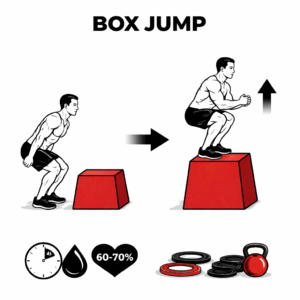
Box jumps are one of the most accessible plyometric exercises and a good introduction to explosive lower-body training.
The movement requires you to generate enough force to jump onto a raised platform while controlling your landing.
Box jumps can train the glutes, quadriceps, and calves while also requiring coordination between your arms and legs.
How to Perform a Box Jump
Stand facing a sturdy box or platform with your feet approximately shoulder-width apart.
Bend slightly at your hips and knees, bringing your arms back naturally.
From this loaded position, drive through your feet and swing your arms forward as you jump upward and forward onto the box.
Land with both feet on the platform.
Absorb the landing by bending your hips and knees rather than locking your legs.
Once you have stabilized yourself, step down from the box and reset before the next repetition.
The original article specifically recommends stepping down rather than repeatedly jumping off the box.
That approach can help you manage unnecessary impact and keep the focus on producing a quality jump.
2. Broad Jumps
Broad jumps train explosive power in the horizontal direction.
Instead of trying to move upward as high as possible, you are trying to project your body forward.
That makes the exercise particularly useful for athletes who need acceleration and horizontal force production.
Runners, field athletes, and court athletes may find this movement especially relevant because forward movement is a major part of their sport.
How to Perform a Broad Jump
Start with your feet around shoulder-width apart.
Bend your hips and knees slightly while swinging your arms backward.
Drive your arms forward and push forcefully through the ground.
Extend your hips, knees, and ankles as you launch your body forward.
Land on both feet with your knees and hips slightly bent to absorb the impact.
Regain your balance before performing the next repetition.
3. Jump Squats
Jump squats are one of the simplest ways to introduce explosive movement into a traditional lower-body exercise.
The basic squat pattern provides the starting position, while the jump requires you to rapidly extend your hips, knees, and ankles.
They can be performed with little or no equipment, making them useful for home workouts as well as athletic training sessions.
How to Perform a Jump Squat
Stand with your feet approximately shoulder-width apart.
Lower into a controlled squat position.
From the bottom of the movement, drive forcefully through the floor and jump upward.
Extend through your hips, knees, and ankles as you leave the ground.
Land softly and immediately prepare for the next repetition.
You do not need to perform an extremely deep squat before every jump.
Use a range that allows you to maintain good positioning and generate power efficiently.
4. Lateral Bounds
Not every sport involves moving straight forward.
Lateral bounds train your ability to produce force from side to side while controlling your body on one leg.
This makes them particularly useful for developing lateral explosiveness and stability.
They can also challenge the muscles around the hips, knees, and ankles as you absorb and redirect force.
How to Perform Lateral Bounds
Start standing on one leg.
Bend slightly through your hip and knee, then push forcefully away from the floor.
Jump laterally toward the opposite side.
Land on the other leg and absorb the movement before stabilizing.
From that position, push off again and bound back toward the starting side.
The original article recommends focusing on both distance and control rather than simply trying to move as far as possible.
That is particularly important with lateral movements.
5. Depth Jumps
Depth jumps are an advanced plyometric exercise designed to challenge reactive strength.
Instead of actively jumping onto a box, you step off a raised platform and immediately perform an explosive jump after landing.
The movement requires you to absorb the force of landing and then quickly redirect that force into another powerful movement.
That makes depth jumps considerably more demanding than basic box jumps.
How to Perform a Depth Jump
Stand on a sturdy box or platform.
Step off rather than jumping upward from the box.
Land on both feet with your knees and hips slightly bent.
As soon as you make contact with the ground, transition into a powerful vertical jump.
Jump as high as you can while maintaining control.
Land softly and reset.
6. Split Jump
The split jump, sometimes called a jump lunge, combines a lunge position with an explosive jump.
It requires each leg to contribute independently while you switch positions in the air.
This makes it a useful exercise for lower-body power, coordination, and dynamic balance.
How to Perform a Split Jump
Begin in a lunge position with one foot forward and the other behind you.
Lower yourself into a controlled lunge.
From that position, drive forcefully through the floor and jump upward.
While you are in the air, switch the position of your legs.
Land with the opposite leg forward.
Absorb the landing and immediately prepare for the next repetition if you can maintain control.
7. Bounding
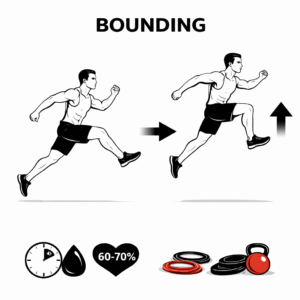
Bounding is a more advanced running drill that emphasizes powerful, exaggerated strides.
Unlike a standard run, bounding encourages you to produce more force with each step and spend more time traveling through the air.
It can be useful for runners and athletes who want to develop stride power.
How to Perform Bounding
Begin moving forward at a controlled pace.
Drive one knee upward while pushing forcefully through the opposite leg.
Reach forward into an exaggerated stride and land on the opposite leg.
Continue alternating sides in a rhythmic pattern.
Use your arms naturally to support the movement.
The original article describes bounding as controlled running with power.
That is a useful way to think about it.
The movement should remain rhythmic rather than becoming a series of uncontrolled maximal jumps.
8. Plyometric Push-Ups
Plyometrics are not limited to the lower body.
Plyometric push-ups train explosive upper-body power by requiring you to push your hands away from the ground.
They primarily challenge the chest, shoulders, and triceps while your core works to keep your body stable.
How to Perform a Plyometric Push-Up
Start in a standard push-up position with your hands under or slightly wider than your shoulders.
Lower your chest toward the floor under control.
From the bottom position, push forcefully into the floor so your hands leave the ground briefly.
Land with your hands in a controlled position and immediately prepare for the next repetition.
9. Skater Hops
Skater hops are another lateral plyometric movement.
They resemble the side-to-side movement of a speed skater and require you to repeatedly jump from one leg to the other.
The exercise trains the glutes, hamstrings, and stabilizing muscles while also challenging coordination and balance.
How to Perform Skater Hops
Stand on one leg with your knee slightly bent.
Push off the ground and jump laterally.
Land on the opposite leg and allow your body to absorb the movement.
Use your arms to help generate momentum and maintain balance.
Then push off the landing leg and move back toward the other side.
10. Clap Jumps
Clap jumps add an upper-body coordination element to a vertical jump.
The basic movement is similar to a jump squat, but you add an overhead clap while airborne.
The exercise can be useful for practicing vertical explosiveness and coordination.
How to Perform Clap Jumps
Start in a comfortable squat position.
Swing your arms naturally as you prepare to jump.
Drive forcefully through your legs and jump vertically.
While airborne, bring your hands together for a clap above your head.
Land softly with your knees and hips slightly bent.
Reset before repeating.
A Simple Beginner Plyometric Workout
If you are new to plyometric training, you do not need a complicated routine.
Start with basic exercises that allow you to practice jumping and landing.
A simple session could begin with jump squats, followed by low box jumps and controlled skater hops.
You might perform a small number of repetitions per set and rest long enough to recover fully before the next set.
For example:
Jump Squats: 3 sets of 5 to 8 repetitions
Box Jumps: 3 sets of 5 repetitions
Skater Hops: 2 sets of 5 repetitions per side
The exact volume should depend on your current ability.
If your landing mechanics deteriorate, reduce the number of repetitions.
The goal of the first few sessions is to learn how to produce and absorb force, not to exhaust yourself.
How to Warm Up for Plyometric Training
Plyometric training should not be the first thing you do immediately after sitting down for several hours.
A gradual warm-up can help prepare you for the demands of explosive movement.
Start with several minutes of light movement to increase your body temperature.
Then move into dynamic movements that prepare your hips, knees, ankles, and upper body depending on the exercises you plan to perform.
You can also practice the movement at a lower intensity before beginning your working sets.
For example, before box jumps, you might perform several controlled bodyweight squats and small jumps.
Before lateral bounds, you could practice controlled side-to-side movements without leaving the ground.
The purpose is to prepare your body without creating fatigue.
Plyometric Training and Strength Training
Plyometrics and strength training can complement one another.
Strength training helps you develop the ability to produce force against resistance.
Plyometric training gives you an opportunity to practice expressing force quickly.
That is one reason athletes often include both forms of training.
A well-rounded program might include squats, deadlifts, lunges, or other strength exercises alongside jumps, bounds, and explosive drills.
However, you do not need to perform every exercise in the same session.
The best structure depends on your goals and experience.
If explosive power is a major priority, plyometric exercises are often best performed when you are relatively fresh.
If you perform exhausting strength work first, your ability to produce high-quality jumps may be reduced.
Best Plyometric Exercises for Speed
If your main goal is improving speed, not every plyometric exercise needs to be performed at maximum intensity.
The most useful movements are those that teach you to produce force quickly while maintaining efficient mechanics.
Bounding can be particularly relevant for runners because it resembles exaggerated running mechanics.
Broad jumps can help develop horizontal power, while lateral bounds and skater hops provide opportunities to train side-to-side force production.
Jump squats and box jumps can also contribute to general lower-body explosiveness.
The important point is to combine plyometric training with the rest of your speed program.
Plyometrics alone do not automatically make someone a faster runner.
Sprint technique, strength, running practice, conditioning, recovery, and training consistency all contribute to speed development.
Best Plyometric Exercises for Vertical Jump
If your goal is to jump higher, vertical jumping exercises should make up a significant part of your plyometric work.
Box jumps can teach explosive takeoff mechanics, while jump squats allow you to practice producing force from a squat position.
Depth jumps are more advanced and can challenge your ability to rapidly transition from landing into another jump.
Clap jumps can also provide a simple vertical jumping variation.
The most important factor is quality.
If you want to improve your vertical jump, you should not turn your training into a high-repetition cardio session.
Perform fewer high-quality jumps and allow enough recovery between demanding sets so you can continue producing powerful efforts.
Best Plyometric Exercises for Runners
Runners can use plyometrics to complement their regular running and strength training.
Bounding is particularly relevant because it emphasizes powerful strides and forceful push-offs.
Lateral bounds and skater hops can introduce side-to-side movement, while broad jumps can challenge horizontal power.
Jump squats can provide a simple lower-body explosive exercise that requires very little equipment.
However, runners should consider their total training load.
Running already places repeated demands on the lower body. Adding a large volume of high-impact plyometric work can create unnecessary fatigue.
Start with a small amount and see how your body responds.
The quality of your running sessions should not suffer because you added too much plyometric work.
Common Plyometric Training Mistakes
One of the most common mistakes is doing too many repetitions.
Plyometric training is not supposed to feel like a traditional high-repetition conditioning workout.
Once fatigue becomes significant, your ability to produce explosive force decreases.
Another mistake is choosing exercises that are too advanced.
Depth jumps, bounding, and other demanding drills require a stronger foundation than simple jump squats or low box jumps.
Start where you are.
There is no advantage in performing an advanced exercise simply because it looks more athletic.
Another common mistake is ignoring landing mechanics.
People often focus on how high they jumped and completely forget how they landed.
Finally, avoid performing explosive exercises when you are so fatigued that you can no longer control your movement.
Quality should determine when a set ends.
Final Thoughts
Plyometric training is about more than jumping as high as possible.
It is about learning to produce force quickly, control your body in the air, absorb force when you land, and transition into another movement efficiently.
That combination makes plyometrics valuable for athletes, runners, and anyone who wants to develop greater explosiveness.
The 10 exercises in this guide provide a range of options.
Box jumps and jump squats are accessible ways to begin developing explosive lower-body movement. Broad jumps can emphasize horizontal power, while lateral bounds and skater hops challenge side-to-side movement.
Split jumps add a unilateral element, and bounding can be particularly useful for runners who want to work on powerful stride mechanics.
Plyometric push-ups bring explosive training to the upper body, while more advanced movements such as depth jumps require greater strength, control, and reactive ability.
You do not need to perform all of them.
Choose exercises that match your current level and your training goals.
If you are new to plyometrics, start with simpler movements and focus on landing mechanics. As your strength and coordination improve, gradually introduce more demanding variations.
Keep the quality of each repetition high.
When your jumps become noticeably lower, your landings become heavy, or your technique begins to break down, the set has probably done its job.
Plyometric training should complement your overall program, not replace strength training, sport practice, running, or recovery.
Used intelligently, it can help you become faster, more explosive, and more confident in powerful movements.
Start with the basics, master your landings, progress gradually, and give your body enough time to recover.
Power is not just about producing more force.
It is about learning to produce that force when it matters.
Last Updated on September 3, 2026
Written By

Join thousands of readers leveling up their fitness.
Skip the guesswork—get insights on training, health, and the right gear to support your progress.
You may also like
How To Do A Lat Pulldown Correctly
The lat pulldown is one of the best exercises for building a wider, stronger…
10 Different Types Of Deadlifts And Their Benefits
The deadlift is one of the most powerful compound exercises for building…

How to Strengthen Your Knees for Running
Strong, healthy knees are essential for runners, whether you’re logging miles…
Compound vs. Isolation Exercises: What’s the Difference?
When it comes to strength training, all exercises can generally be divided into…
Back Squat Exercise Guide: How to Master Back Squats
The back squat is one of the most effective strength training exercises for…
10 Medicine Ball Ab Exercises You Need To Try
If you’re tired of traditional crunches and planks, it’s time to add some…