

Looking to grow stronger, rounder glutes? The hip thrust is one of the most powerful exercises for building your backside. But if your form is off, you’ll miss the benefits—and possibly hurt yourself.
This guide breaks down proper hip thrust form, from setup to execution, so you can activate your glutes fully, protect your lower back, and make every rep count.
Why Hip Thrusts Are So Effective
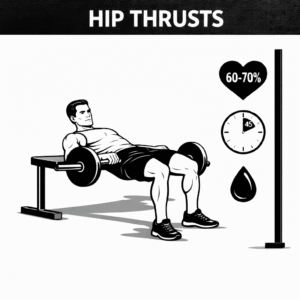
The hip thrust isolates and strengthens your glutes better than most lower-body exercises, including squats and deadlifts. It also reduces the stress on your lower back and knees.
Benefits of Hip Thrusts:
- Builds glute size and strength
- Improves athletic performance and hip extension power
- Helps fix muscle imbalances
- Reduces risk of injury
- Complements squats and deadlifts
Step-by-Step: How to Do a Hip Thrust with Perfect Form
Let’s start with the barbell hip thrust, the most popular variation for glute building.
Step 1: Set Up Your Bench and Barbell
- Use a flat bench that won’t move or tip.
- Sit on the floor with your upper back against the bench.
- Roll a barbell over your hips or place it with help if it’s loaded.
Tip: Use a barbell pad or towel to cushion your hips.
Step 2: Find the Right Position
- Bend your knees with your feet flat, about shoulder-width apart.
- Align your upper back (just below the shoulder blades) on the bench edge.
- Your shins should be vertical at the top of the movement.
Step 3: Brace and Thrust
- Tuck your chin slightly and look forward.
- Drive through your heels, pushing your hips toward the ceiling.
- Squeeze your glutes hard at the top.
- Your body should form a straight line from shoulders to knees.
Step 4: Control the Descent
- Lower your hips with control until your glutes nearly touch the ground.
- Keep tension in the glutes—don’t rest at the bottom.
- Repeat for your desired reps.
Reps: 3–4 sets of 8–12 reps for glute growth
Key Cues for Proper Hip Thrust Form
- Chin tucked (avoid hyperextending your neck)
- Eyes forward—not looking at the ceiling
- Feet planted flat with heels under knees
- Back resting on the bench edge—not too high or low
- Glutes squeezed at the top—don’t over-arch your lower back
Common Hip Thrust Mistakes to Avoid
Hyperextending the Back
Overarching your spine at the top puts stress on your lower back.
Fix: Keep your ribs down and engage your core.
Feet Too Far Forward or Back
This shifts tension to your quads or hamstrings instead of your glutes.
Fix: Adjust foot placement until your shins are vertical at the top.
Not Using Full Range of Motion
Partial reps mean less activation.
Fix: Lower your hips fully, then thrust until your hips are level with your knees.
Looking Up at the Ceiling
It can cause spinal misalignment and tension in the neck.
Fix: Keep your gaze forward and chin tucked.
Hip Thrust Variations for All Levels
1. Bodyweight Hip Thrust
Best for beginners to learn the movement without a load.
2. Banded Hip Thrust
Add a resistance band above the knees to engage the glute medius.
3. Dumbbell Hip Thrust
Place a dumbbell on your hips if you don’t have a barbell.
4. Hip Thrust Machine
Offers a safer, more stable environment—ideal for beginners or rehab.
5. Single-Leg Hip Thrust
Advanced move to target one glute at a time and improve stability.
How Often Should You Do Hip Thrusts?
For most people focused on glute growth:
- 2–3 times per week
- Combine with squats, lunges, and deadlifts for a balanced lower-body program
Rest 48 hours between sessions for recovery.
FAQs About Hip Thrusts
What muscles do hip thrusts work?
Primarily the glutes, but also activate hamstrings, core, and hip adductors.
Should I use a barbell or a dumbbell?
Use what’s available. Barbells are ideal for heavy loading; dumbbells work well for moderate resistance or home workouts.
Why don’t I feel it in my glutes?
Check your form—especially foot placement and glute squeeze at the top.
Can I do hip thrusts at home?
Yes. Use a couch or bench and a dumbbell or resistance band.
Conclusion:
Hip thrusts are one of the best exercises for building glutes—if done correctly. Focus on proper form, consistent tension, and controlled reps. Whether you’re a beginner or experienced lifter, mastering this movement will take your lower-body training to the next level.
Take your time, follow these steps, and start thrusting your way to stronger, more powerful glutes.
Written By

Join thousands of readers leveling up their fitness.
Skip the guesswork—get insights on training, health, and the right gear to support your progress.
You may also like
How To Do A Lat Pulldown Correctly
The lat pulldown is one of the best exercises for building a wider, stronger…
10 Different Types Of Deadlifts And Their Benefits
The deadlift is one of the most powerful compound exercises for building…

How to Strengthen Your Knees for Running
Strong, healthy knees are essential for runners, whether you’re logging miles…

Compound vs. Isolation Exercises: What’s the Difference?
When it comes to strength training, all exercises can generally be divided into…
Back Squat Exercise Guide: How to Master Back Squats
The back squat is one of the most effective strength training exercises for…
10 Medicine Ball Ab Exercises You Need To Try
If you’re tired of traditional crunches and planks, it’s time to add some…