

If you want your glutes to look stronger, rounder, and more developed through the upper portion, your training should include exercises that challenge the muscles around the upper and outer glute area.
The upper glutes contribute to the shape and appearance of the upper portion of the buttocks. They also play an important role in hip movement and stability. Developing this area does not come from one magic exercise or a quick workout. It comes from consistently training the glutes with a combination of resistance exercises, controlled movement, and progressive overload.
That is where an effective upper glute workout can make a difference.
Some exercises allow you to use heavier resistance and build overall glute strength, while others are better suited to controlled, targeted work. Hip thrusts and glute bridges can provide a strong foundation for glute development, while movements such as cable hip abductions, banded side walks, and lateral step-ups can challenge the muscles around the outer and upper portion of the glutes.
You also do not need to spend every workout in a gym. Several effective upper glute exercises can be performed at home with a resistance band, dumbbells, or simply your body weight.
This guide covers eight effective exercises for developing the upper glutes, explains how to perform each one, and shows you how to put them together into a practical workout.
What Are the Upper Glutes?
When people talk about the “upper glutes” or the “glute shelf,” they are generally referring to the upper portion of the glute area that contributes to the appearance of lift and fullness near the top of the buttocks.
The glutes are made up of several muscles, with the gluteus maximus being the largest. The gluteus medius and gluteus minimus sit more toward the upper and outer portion of the hip and contribute to hip stability and movement.
Because these muscles work together during many lower-body exercises, you cannot completely isolate one small section of the glutes with every movement. However, you can choose exercises that place greater emphasis on hip extension, abduction, and single-leg stability.
This is why a good upper shelf glute workout should include more than one type of exercise.
A combination of hip extension movements, lateral movements, and unilateral exercises gives you a more complete approach to glute training. It also helps prevent your workouts from becoming repetitive.
8 Best Upper Glute Exercises
The following exercises cover a range of movement patterns and training styles. Some are best suited to gym workouts, while others can easily be adapted for an upper glute workout at home.
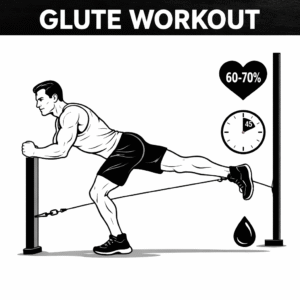
1. Cable Kickbacks
Cable kickbacks are a popular glute isolation exercise because the cable provides resistance while you move the leg backward.
The exercise can be adjusted to emphasize different areas depending on the path of your leg. A slight diagonal path can help bring the upper and outer glute area into the movement while still allowing you to focus on hip extension.
Because the movement is relatively simple, it can work well toward the middle or end of a glute workout when you want to accumulate additional training volume without using very heavy weights.
How to Perform Cable Kickbacks
Attach an ankle strap to a low cable pulley and secure it around one ankle. Stand facing the machine and hold onto the frame or a suitable support for balance.
Start with your working leg underneath your body. Brace your core and keep your torso relatively still.
From there, drive the working leg backward and slightly upward. Focus on moving from the hip rather than swinging the entire leg.
At the end of the movement, squeeze the glute briefly before bringing your leg back to the starting position under control.
Avoid using momentum. If your torso starts leaning forward or your leg is swinging, reduce the weight.
For a controlled set, aim for around 12 to 15 repetitions per side.
2. Dumbbell Lateral Step-Ups
Lateral step-ups add a side-to-side component to a traditional step-up and can be particularly useful for training the glutes while also challenging balance and single-leg strength.
Because you are stepping onto a raised surface from the side, the working leg has to help stabilize the hip as you lift your body upward.
This makes the exercise a useful addition to an upper glute workout when you want something more dynamic than an isolation movement.
How to Perform Dumbbell Lateral Step-Ups
Stand beside a sturdy bench or platform that is appropriate for your strength level. Hold a dumbbell in each hand with your arms relaxed at your sides.
Place the foot closest to the bench onto the platform.
Press through that foot and use the working leg to lift your body onto the platform. Keep your chest controlled and avoid pushing excessively from the trailing leg.
Once you are standing on the platform, lower yourself back down slowly.
Focus on making the working glute control the movement rather than simply stepping up and dropping back down.
Perform approximately 10 to 12 repetitions per leg.
If you are new to the exercise, begin without dumbbells until you are comfortable with the movement.
3. Glute Bridge With Abduction
The glute bridge with abduction combines hip extension with an outward movement of the knees.
This makes it particularly useful when you want to train the glutes through more than one movement pattern in the same exercise.
It is also one of the easiest exercises to include in an at-home upper glute workout because it requires very little equipment.
A resistance band placed above the knees can provide additional challenge during the abduction portion.
How to Perform the Glute Bridge With Abduction
Lie on your back with your knees bent and your feet planted firmly on the floor.
Place a resistance band around your thighs just above the knees if you are using one.
Brace your core and drive through your feet to raise your hips from the floor. Continue until your hips are fully extended without excessively arching your lower back.
At the top, push your knees gently outward against the resistance band.
Pause briefly and squeeze your glutes before returning your knees to their original position and lowering your hips.
The movement should be controlled from beginning to end.
Aim for 3 sets of approximately 15 repetitions.
You can make the exercise harder by using a stronger band or adding resistance across your hips once your technique is consistent.
4. Curtsy Lunges
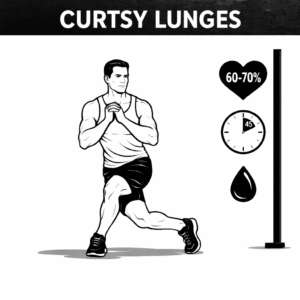
Curtsy lunges introduce a diagonal movement pattern that challenges the glutes, thighs, balance, and hip stability.
Unlike a standard forward or reverse lunge, the working leg moves behind and across the body. This changes the demands placed on the hips and requires you to control your body throughout the movement.
The exercise can be performed with body weight or with dumbbells once you have developed sufficient balance and control.
How to Perform Curtsy Lunges
Stand with your feet roughly hip-width apart.
Take your right leg diagonally behind your left leg and lower your body into a controlled lunge.
Keep your front foot planted and maintain control through the working hip and knee. Your front knee should remain aligned with the direction of your toes.
Press through the working foot to return to your starting position.
Repeat on the opposite side.
The movement should feel controlled rather than rushed. If balance becomes difficult, reduce the depth of the lunge or perform the exercise without additional weight.
A range of 12 to 14 repetitions per side can work well for this exercise.
5. Single-Leg Romanian Deadlift
The single-leg Romanian deadlift is one of the most demanding exercises on this list because it combines glute and hamstring training with balance and stability.
The movement is based around a hip hinge. Instead of squatting down, you push your hips backward while keeping a relatively straight torso.
Because you are working one leg at a time, the exercise can also reveal differences in balance and strength between the two sides.
How to Perform the Single-Leg Romanian Deadlift
Stand tall while holding a dumbbell in each hand.
Shift your weight onto one leg and keep a slight bend in the working knee.
Begin pushing your hips backward while your upper body moves forward. At the same time, allow your free leg to extend behind you for balance.
Lower the dumbbells toward the floor while keeping your back controlled.
Once you reach a comfortable range of motion, drive your hips forward and squeeze the working glute to return to standing.
You do not need to touch the dumbbells to the floor. Your range of motion should be determined by your mobility and ability to maintain good technique.
Start with 8 to 10 repetitions per leg.
If balance is a problem, hold onto a stable surface with one hand while learning the movement.
6. Standing Cable Hip Abduction
Standing cable hip abduction is one of the more targeted exercises for the muscles around the outer hip and upper glute area.
Instead of moving the leg backward, you move it outward away from the center of your body.
The movement is small, so there is no need to use a large amount of weight. In fact, going too heavy can make the exercise harder to control and encourage you to lean your torso to compensate.
How to Perform Standing Cable Hip Abduction
Attach an ankle strap to a low cable pulley.
Stand sideways to the machine and hold onto the frame for balance.
Position the leg attached to the cable on the outside.
Keeping your torso still, slowly move the working leg outward away from your body.
Pause briefly when you reach a comfortable range of motion, then return the leg slowly.
Try not to swing the leg or rotate your hips.
The goal is controlled movement rather than maximum range.
Around 15 repetitions per side is a practical starting point.
7. Banded Side Walks
Banded side walks are simple, but they can be surprisingly challenging when performed correctly.
They are especially useful for an upper glute workout at home because they require only a resistance band and a small amount of space.
The exercise keeps the glutes under tension while you take controlled steps from side to side.
How to Perform Banded Side Walks
Place a resistance band around your thighs just above your knees. If you want more resistance, you can use a band around the ankles or feet once you are comfortable with the movement.
Stand with your feet roughly hip-width apart and bend your knees slightly.
Push your hips back and maintain a stable athletic position.
Step sideways while keeping tension on the band. Follow with the opposite foot without allowing your feet to completely lose the resistance.
Continue for several steps in one direction before returning the other way.
Keep your torso stable throughout the movement.
A useful starting point is 10 steps in each direction, repeated for several rounds.
The most common mistake is standing too tall and allowing the band to become loose between steps. Stay controlled and maintain consistent tension.
8. Hip Thrust
The hip thrust is one of the most effective compound exercises for building overall glute strength and size.
Unlike some of the more targeted movements in this workout, the hip thrust allows you to use significantly more resistance. That makes it useful for progressive overload and long-term strength development.
It is also easy to modify. Beginners can start with body weight, while more experienced lifters can use a barbell or other forms of resistance.
How to Perform the Hip Thrust
Sit on the floor with your upper back supported against a sturdy bench.
Position a barbell across your hips using appropriate padding for comfort.
Plant your feet firmly on the floor and brace your core.
Drive through your feet and extend your hips upward.
At the top, your torso should form a relatively straight line from your shoulders toward your knees.
Squeeze your glutes at the top without aggressively arching your lower back.
Lower your hips under control and repeat.
For muscle-building work, 8 to 12 controlled repetitions can be a useful starting range.
The key is to make the glutes perform the movement. If you feel most of the work in your lower back, reassess your foot position, range of motion, and technique.
How to Workout the Upper Glute Effectively
Training the upper glutes effectively is not simply about feeling a burn.
You need to create enough training stimulus to encourage your muscles to adapt over time.
One of the most important factors is progressive overload. As you become stronger, gradually increase the resistance, repetitions, or overall training volume while keeping your technique consistent.
You should also avoid rushing through your repetitions. A slower, controlled movement can make it easier to maintain the correct position and understand which muscles are working.
Exercise selection matters as well. Rather than performing several exercises that all train the glutes in almost exactly the same way, combine movements that challenge the hips from different directions.
Finally, consistency is critical. A single intense glute workout will not dramatically change your physique. Results come from repeating effective training over weeks and months.
Tips for Building Upper Glutes
How Often Should You Train Your Glutes?
For many people, two to three glute-focused sessions per week can be a practical approach, provided there is enough recovery between sessions.
You do not need to train the glutes hard every day.
Your muscles need time to recover and adapt after resistance training. If you are already performing squats, lunges, deadlifts, or other lower-body exercises, remember that these movements can also contribute to your overall glute training volume.
The right frequency depends on your complete workout schedule.
If your glutes are still sore or your performance is consistently declining, adding more training may not be the solution. Better recovery, nutrition, sleep, and exercise management may be more appropriate.
Progressive Overload for Upper Glute Growth
Progressive overload is one of the most important principles for building muscle.
Your body adapts to the demands you place on it. Once a particular weight and repetition range becomes easier, you can gradually increase the challenge.
That does not always mean adding more weight.
You can increase repetitions, add resistance through a stronger band, improve your range of motion, increase the number of quality sets, or improve your control over each repetition.
For example, if you can perform hip thrusts with a certain weight for 10 controlled repetitions, you might eventually work toward 12 repetitions before increasing the resistance.
The same principle applies to banded side walks and cable exercises. Progress should be gradual and controlled.
The Importance of the Mind-Muscle Connection
You will often hear people talk about the “mind-muscle connection” during glute training.
The basic idea is to pay attention to the muscle you are trying to train instead of simply moving the resistance from one position to another.
This can be especially helpful with exercises such as cable kickbacks and hip abductions, where using momentum can easily take over.
Instead of thinking about moving your leg as far as possible, focus on maintaining control and contracting the target muscles.
However, the mind-muscle connection should not replace progressive overload. You still need sufficient resistance and consistent training to make meaningful progress.
Upper Glute Workout at Home
You do not need a cable machine or barbell to train your glutes effectively.
A resistance band and body weight can provide enough challenge for a practical at-home workout, especially if you are a beginner or are working with limited equipment.
Here is a simple routine based on the exercises in this guide.
At-Home Upper Glute Workout
Start with glute bridges with abduction for 3 sets of 15 repetitions. Focus on controlled hip extension and maintain tension in the band as you move your knees outward.
Next, perform banded side walks for 3 rounds of 20 total steps. Stay in a slightly lowered position and avoid allowing the band to lose tension.
Follow with curtsy lunges for 3 sets of 12 repetitions per leg. Keep the movement controlled and use body weight until your balance and technique are solid.
Finish with single-leg glute bridges for 3 sets of 10 repetitions per leg. Concentrate on extending the hips without arching your lower back.
Rest as needed between sets. If the workout becomes too easy, increase the resistance or gradually add repetitions while maintaining good form.
Common Upper Glute Training Mistakes
Only Performing One Exercise
Doing hundreds of repetitions of one glute exercise does not automatically produce better results.
Different movements challenge the glutes in different ways. A balanced program should include a combination of exercises rather than relying on one movement.
Using Too Much Momentum
Momentum can make almost any exercise easier by shifting work away from the target muscles.
This is particularly common with cable kickbacks and hip abductions.
If you cannot control the weight, reduce the resistance.
Sacrificing Form for More Repetitions
More repetitions are not always better.
Once your technique breaks down, the quality of the exercise decreases. It is better to complete fewer controlled repetitions than to continue with sloppy movement simply to reach a target number.
Neglecting Progressive Overload
Repeating exactly the same workout with exactly the same resistance indefinitely may eventually limit your progress.
Your training should evolve as your strength improves.
Training Too Frequently
More training is not automatically better.
If you continually train the glutes without giving them enough time to recover, your performance can suffer.
Build a schedule that allows you to train hard while still recovering between sessions.
Final Thoughts
Building stronger, fuller glutes takes more than finding one exercise and repeating it every day.
The most effective approach is to combine different movements that challenge the glutes through hip extension, lateral movement, and single-leg work. Exercises such as hip thrusts and glute bridges provide a strong foundation, while cable kickbacks, hip abductions, banded side walks, and lateral step-ups allow you to add more targeted work.
The eight exercises in this guide give you plenty of options whether you train in a fully equipped gym or prefer an upper glute workout at home.
You also do not need to make every workout extremely complicated. Choose a few exercises, perform them with good technique, and gradually increase the challenge as you become stronger.
Most importantly, give your training time to work.
Glute development is a gradual process. Consistent resistance training, appropriate recovery, good nutrition, and progressive overload will always matter more than constantly searching for a new exercise.
Build your routine around movements you can perform well, stay consistent, and make steady progress. That is the foundation for stronger, more developed glutes and a more effective upper glute workout.
Last Updated on August 28, 2026
Written By

Join thousands of readers leveling up their fitness.
Skip the guesswork—get insights on training, health, and the right gear to support your progress.
You may also like
How To Do A Lat Pulldown Correctly
The lat pulldown is one of the best exercises for building a wider, stronger…
10 Different Types Of Deadlifts And Their Benefits
The deadlift is one of the most powerful compound exercises for building…
How to Strengthen Your Knees for Running
Strong, healthy knees are essential for runners, whether you’re logging miles…
Compound vs. Isolation Exercises: What’s the Difference?
When it comes to strength training, all exercises can generally be divided into…
Back Squat Exercise Guide: How to Master Back Squats
The back squat is one of the most effective strength training exercises for…
10 Medicine Ball Ab Exercises You Need To Try
If you’re tired of traditional crunches and planks, it’s time to add some…