

Push-ups have remained one of the most trusted bodyweight exercises for decades, and for good reason. They require no equipment, can be performed almost anywhere, and strengthen multiple muscle groups with a single movement. Whether you’re just beginning your fitness journey or have years of training experience, push-ups offer a simple yet highly effective way to improve strength, endurance, and overall fitness.
Many people think of push-ups as a chest exercise, but they do much more than build your pectoral muscles. Every repetition challenges your shoulders, triceps, core, back, glutes, and even your legs. When performed with proper form, a push-up becomes a full-body movement that develops stability, coordination, and functional strength that carries over into everyday activities.
Push-ups are also highly adaptable. Beginners can start with easier variations such as wall or incline push-ups, while advanced athletes can increase the challenge with explosive or single-arm versions. This flexibility makes push-ups one of the few exercises that can continue to challenge you regardless of your fitness level.
In this guide, you’ll learn how to perform a push-up correctly, understand the muscles it targets, discover common mistakes to avoid, and explore four complete push-up workouts designed for beginners, intermediate exercisers, strength builders, and endurance athletes.
Benefits of Regular Push-Up Training
Push-ups offer far more than stronger arms and a bigger chest.
Performing push-ups consistently improves upper-body strength, making everyday activities such as lifting groceries, pushing heavy doors, or carrying luggage feel easier.
The exercise also develops muscular endurance. Over time, your muscles become better at sustaining repeated effort, allowing you to perform physical tasks with less fatigue.
Since your core remains engaged throughout every repetition, push-ups naturally strengthen your abdominal muscles without requiring separate core exercises. This improved stability contributes to better posture and spinal support.
Another major benefit is joint stability. When performed correctly, push-ups strengthen the muscles surrounding the shoulders, improving control during pressing movements and reducing the likelihood of poor movement patterns.
For individuals interested in weight management, push-ups increase overall energy expenditure by engaging multiple large muscle groups simultaneously. While they are not a substitute for cardiovascular exercise, they make an excellent addition to any balanced fitness program.
How to Do a Push-Up with Proper Form
Proper technique is the foundation of every effective push-up. Good form not only improves muscle activation but also reduces unnecessary stress on your shoulders, wrists, and lower back.
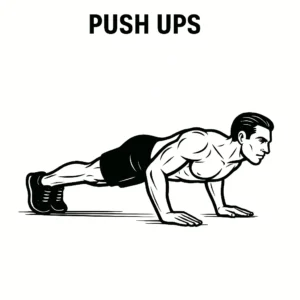
Begin in a high plank position with your hands slightly wider than shoulder-width apart. Spread your fingers comfortably across the floor to create a stable base.
Extend your legs behind you and keep your feet together or slightly apart. Tighten your core and glutes so your body forms a straight line from your head to your heels.
Slowly bend your elbows while lowering your chest toward the floor. Your elbows should angle backward at roughly 45 degrees rather than flaring directly out to the sides.
Lower until your chest is just above the floor while maintaining full-body tension. Avoid allowing your hips to sag or your shoulders to shrug toward your ears.
Press firmly through your palms to straighten your arms and return to the starting position. Focus on controlled movement rather than speed.
Quality repetitions are always more beneficial than rushing through a large number of poorly executed push-ups.
Common Push-Up Mistakes
Many people unknowingly reduce the effectiveness of push-ups by developing poor movement habits.
A common mistake is allowing the hips to sag. This places unnecessary stress on the lower back while reducing core engagement. Keeping your abdominal muscles tight helps maintain proper alignment.
Another mistake is raising the hips too high. While this may make the exercise easier, it shifts the workload away from the chest and shoulders.
Many beginners also flare their elbows excessively. This places additional stress on the shoulder joints and reduces pressing efficiency. Keeping the elbows closer to the body creates a stronger and safer movement pattern.
Finally, avoid performing only partial repetitions. Lowering only halfway limits muscle activation and slows progress. Instead, move through a comfortable but complete range of motion while maintaining proper technique.
Workout 1: Beginner Push-Up Foundation
If you’re new to push-ups, the goal should be building confidence and mastering proper form before increasing difficulty.
Start with incline push-ups using a bench, countertop, or sturdy table. Perform 12 repetitions before moving to knee push-ups for another 10 repetitions.
Finish the workout with a 30-second high plank to strengthen your core and reinforce proper body alignment.
Complete three rounds while resting for one minute between each round.
This workout develops the foundational strength needed for standard floor push-ups without overwhelming beginners.
Workout 2: Upper Body Strength Builder
Once you can comfortably perform 10 to 15 standard push-ups with good form, it’s time to build more strength. This workout increases the workload on your chest, shoulders, triceps, and core while reinforcing proper technique.
Begin with standard push-ups and perform 10 to 12 controlled repetitions. Focus on lowering your body slowly and pressing back up with power while keeping your core engaged.
After a short rest, perform wide-grip push-ups. Placing your hands slightly wider than shoulder-width shifts more of the workload to your chest and front shoulders. Complete 8 to 10 repetitions while maintaining the same controlled tempo.
Next, perform close-grip push-ups, often called narrow push-ups. Bringing your hands closer together increases the demand on your triceps while still engaging your chest and shoulders. Aim for 8 to 10 repetitions.
Finish each round with a 30 to 45-second plank to strengthen your core and improve the stability needed for better push-up performance.
Complete three to four rounds, resting 60 to 90 seconds between each round.
As your strength improves, increase the number of repetitions or slow the lowering phase to create additional time under tension.
Workout 3: Push-Up Endurance Challenge
Building muscular endurance allows you to perform more push-ups without fatigue while improving your overall conditioning.
This workout uses a circuit format with minimal rest to keep your muscles working continuously.
Start with 15 standard push-ups followed immediately by 12 incline push-ups.
Next, perform 10 shoulder tap push-ups. After each push-up, tap one hand to the opposite shoulder before completing the next repetition. This variation significantly increases core activation and shoulder stability.
Finish the circuit with a 45-second high plank hold.
Rest for one minute before repeating the circuit three or four times.
This workout is particularly effective for athletes, military fitness preparation, obstacle course training, and anyone looking to improve muscular endurance.
Remember that maintaining excellent technique is more important than completing extra repetitions. If your form begins to break down, stop, rest briefly, and continue only when you can perform the movement correctly.
Workout 4: Advanced Total Body Push-Up Workout
For experienced exercisers looking for a greater challenge, this advanced workout develops explosive power, unilateral strength, and total-body coordination.
Begin with explosive push-ups, pressing hard enough for your hands to briefly leave the floor. Perform six to eight repetitions while focusing on soft, controlled landings.
Next, complete eight diamond push-ups. Position your hands close together beneath your chest to increase emphasis on your triceps and inner chest.
Follow with eight Spiderman push-ups. As you lower your body, bring one knee toward the elbow on the same side before returning to the starting position. Alternate sides with each repetition.
Complete the circuit with decline push-ups by placing your feet on a bench or sturdy platform. Perform eight to ten repetitions while maintaining a straight body position.
Rest for 90 seconds before repeating the circuit three times.
This workout demands excellent upper-body strength, core stability, and coordination. If any variation cannot be performed with proper technique, substitute a standard push-up until sufficient strength has been developed.
Muscles Worked During Push-Ups
Although push-ups are often associated with chest development, they are actually a compound exercise that recruits multiple muscles throughout your body.
The primary muscle involved is the pectoralis major, which generates the force needed to push your body away from the floor.
Your triceps extend your elbows during every repetition, making them one of the hardest-working muscle groups throughout the movement.
The front portion of your shoulders, known as the anterior deltoids, assists with pressing while helping stabilize your upper body.
Your abdominal muscles and lower back work continuously to maintain a straight body position. Without a strong core, your hips would sag or rise excessively, reducing the effectiveness of the exercise.
Even your glutes, quadriceps, and calves contribute by maintaining lower-body stability throughout each repetition.
Because so many muscles work together, push-ups provide excellent value for anyone looking to improve total-body strength using only body weight.
How to Progress Your Push-Ups
One of the biggest mistakes people make is performing the same number of push-ups every workout. Your body adapts quickly, so gradually increasing the challenge is necessary for continued improvement.
The simplest way to progress is by adding repetitions. If you currently perform 10 repetitions comfortably, aim for 11 or 12 during your next workout.
You can also increase the number of sets or reduce your rest periods to improve muscular endurance.
Another effective strategy is slowing the lowering phase of each repetition. Taking three to five seconds to descend increases muscle tension and improves control without requiring additional equipment.
Once bodyweight push-ups become relatively easy, consider incorporating weighted push-ups using a weight vest or resistance plates under appropriate supervision.
Advanced exercisers may also progress to single-arm progressions, archer push-ups, or ring push-ups, each of which introduces new stability and strength demands.
Recovery Tips for Better Results
Training stimulates muscle growth, but recovery is where your body adapts and becomes stronger.
Allow at least 48 hours before performing another intense push-up workout targeting the same muscle groups. This recovery period gives your muscles time to repair and grow.
Adequate protein intake supports muscle recovery, while staying hydrated helps maintain muscle function and joint health.
Sleep also plays a critical role in strength development. Aim for seven to nine hours of quality sleep each night to maximize recovery and athletic performance.
If your muscles feel particularly sore, light movement such as walking, gentle stretching, or mobility exercises can help improve circulation without placing excessive stress on recovering muscles.
Final Thoughts
Push-ups remain one of the most effective exercises for developing upper-body strength, improving muscular endurance, and building a stable core without requiring expensive equipment or a gym membership. Their simplicity, versatility, and scalability make them suitable for beginners learning proper movement patterns as well as experienced athletes seeking a greater challenge.
The four workouts in this guide provide a structured way to improve your fitness regardless of your current ability. Beginners can focus on building a strong foundation with modified variations, while intermediate and advanced exercisers can continue progressing through increased resistance, more demanding movements, and higher training volumes.
Remember that long-term success comes from consistency rather than intensity. Prioritize proper technique, progress gradually, and allow your body enough time to recover between workouts. Combined with a balanced training program and healthy lifestyle habits, push-ups can help you build strength, improve posture, enhance athletic performance, and support better overall fitness.
Whether your goal is to complete your first full push-up or master advanced variations, every repetition brings you one step closer to becoming stronger, more capable, and more confident in your abilities.
Last Updated on August 4, 2026
Written By

Join thousands of readers leveling up their fitness.
Skip the guesswork—get insights on training, health, and the right gear to support your progress.
You may also like
How To Do A Lat Pulldown Correctly
The lat pulldown is one of the best exercises for building a wider, stronger…
10 Different Types Of Deadlifts And Their Benefits
The deadlift is one of the most powerful compound exercises for building…

How to Strengthen Your Knees for Running
Strong, healthy knees are essential for runners, whether you’re logging miles…

Compound vs. Isolation Exercises: What’s the Difference?
When it comes to strength training, all exercises can generally be divided into…
Back Squat Exercise Guide: How to Master Back Squats
The back squat is one of the most effective strength training exercises for…
10 Medicine Ball Ab Exercises You Need To Try
If you’re tired of traditional crunches and planks, it’s time to add some…