

The Romanian Deadlift (RDL) is one of the most effective exercises for building posterior chain strength, targeting your hamstrings, glutes, and lower back. Unlike the conventional deadlift, the RDL emphasizes controlled movement, flexibility, and stability, making it ideal for improving spine health and developing functional strength.
Whether you’re training for performance, aesthetics, or injury prevention, incorporating different RDL variations keeps your workouts effective and your progress steady.
Why RDLs Are Essential
RDLs focus on the eccentric (lowering) phase of the lift, which helps strengthen muscles while protecting joints and connective tissues. They improve hip hinge mechanics, enhance flexibility, and reduce the risk of lower back injuries by promoting proper spinal alignment and control.
Key Benefits:
- Builds hamstring and glute strength
- Improves hip mobility and flexibility
- Strengthens the lower back
- Enhances posture and core stability
- Reduces injury risk from poor lifting mechanics
1. Conventional Barbell RDL
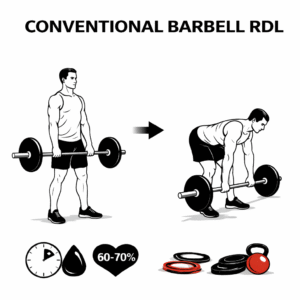
The standard version of the RDL is ideal for overall strength and power.
How to do it:
Hold a barbell with an overhand grip, feet hip-width apart. With a slight bend in your knees, hinge at your hips, and lower the bar along your thighs until you feel a stretch in your hamstrings. Return to the starting position by driving through your heels.
Pro Tip:
Keep your back flat and core braced throughout the movement.
2. Dumbbell RDL
A more versatile alternative that allows a greater range of motion and balance work.
How to do it:
Hold a dumbbell in each hand, palms facing your thighs. Lower the weights toward your shins while hinging at your hips. Pause briefly, then squeeze your glutes to return upright.
Pro Tip:
Keep the dumbbells close to your legs and move slowly for maximum tension.
3. Single-Leg RDL
This unilateral variation improves balance, coordination, and glute activation.
How to do it:
Stand on one leg with a dumbbell in the opposite hand. Hinge forward while extending your free leg straight behind you. Keep your spine neutral and return to standing.
Pro Tip:
Move slowly and focus on stability, not speed. Start without weights if necessary.
4. Banded RDL
Perfect for developing explosive hip drive and constant tension throughout the lift.
How to do it:
Attach a resistance band under your feet and around your hips or hands. Perform the RDL movement as usual; the band increases resistance as you stand up.
Pro Tip:
Use moderate resistance to maintain good form and tempo.
5. Deficit RDL
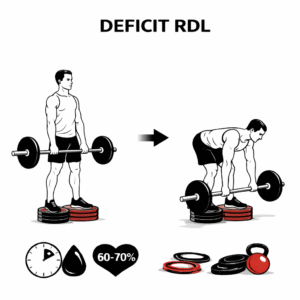
This advanced variation increases the range of motion to enhance flexibility and hamstring recruitment.
How to do it:
Stand on a low platform (2–4 inches high) and perform the RDL as normal, allowing the bar to lower slightly deeper than usual.
Pro Tip:
Avoid rounding your lower back, focus on controlled movement and depth.
6. Snatch-Grip RDL
A wide-grip version that engages the upper back and traps along with the posterior chain.
How to do it:
Hold the barbell with a wide (snatch) grip and perform a standard RDL. The wider grip shifts more emphasis to your upper back and lats.
Pro Tip:
Keep your chest tall and shoulders retracted to maintain posture.
7. Kettlebell RDL
A beginner-friendly option that teaches proper hip hinge mechanics.
How to do it:
Hold a kettlebell with both hands at hip level. Push your hips back while lowering the kettlebell between your legs. Drive through your heels to stand up.
Pro Tip:
Keep the movement smooth and controlled, and avoid bending your knees excessively.
8. Trap Bar RDL
Easier on the lower back and great for beginners or athletes focused on power.
How to do it:
Step inside the trap bar, grip the handles, and hinge at the hips while lowering the bar toward the floor. Drive up through your heels to stand tall.
Pro Tip:
This neutral grip variation reduces shoulder strain and supports better posture.
9. Seated RDL
Targets the hamstrings while removing lower back stress.
How to do it:
Sit on a bench with your feet flat and hold dumbbells or a barbell on your thighs. Lean forward at the hips until you feel a stretch in your hamstrings, then return upright.
Pro Tip:
Keep your spine neutral and avoid rounding your shoulders.
10. Single-Arm RDL
A challenging variation that tests unilateral control and core stability.
How to do it:
Hold one dumbbell in one hand and perform an RDL while keeping your shoulders level. This helps identify and correct muscle imbalances.
Pro Tip:
Engage your core to prevent rotation and keep movement controlled.
Final Thoughts
RDL variations are among the most effective ways to strengthen your posterior chain, improve spine health, and enhance overall athletic performance. Whether you prefer barbell, dumbbell, or bodyweight versions, the key is maintaining proper form and slow, controlled movement.
Add 2–3 of these RDL variations to your training routine to build stronger glutes, hamstrings, and a resilient lower back.
Written By

Join thousands of readers leveling up their fitness.
Skip the guesswork—get insights on training, health, and the right gear to support your progress.
You may also like
How To Do A Lat Pulldown Correctly
The lat pulldown is one of the best exercises for building a wider, stronger…

10 Different Types Of Deadlifts And Their Benefits
The deadlift is one of the most powerful compound exercises for building…

How to Strengthen Your Knees for Running
Strong, healthy knees are essential for runners, whether you’re logging miles…

Compound vs. Isolation Exercises: What’s the Difference?
When it comes to strength training, all exercises can generally be divided into…
Back Squat Exercise Guide: How to Master Back Squats
The back squat is one of the most effective strength training exercises for…
10 Medicine Ball Ab Exercises You Need To Try
If you’re tired of traditional crunches and planks, it’s time to add some…