

Building strong legs does not always mean loading up a barbell and performing another set of squats.
Bilateral exercises, where both legs work at the same time, are an important part of strength training. But there is another category of lower-body exercises that deserves a regular place in many training programs: single-leg exercises.
Single-leg exercises, also known as unilateral exercises, train one side of the body at a time. That simple change can make familiar movements considerably more demanding.
When one leg has to handle most or all of the work, you cannot rely on your stronger side to compensate for the weaker one. You also have to control your balance, maintain your position, and coordinate your movement without allowing your body to shift unnecessarily.
That makes single-leg training useful for much more than building bigger quads or glutes.
It can help you develop better control, improve balance, strengthen the muscles around your hips and knees, and identify differences between your left and right sides. For athletes, unilateral training can also provide a useful way to practice movements that resemble the demands of running, jumping, cutting, and changing direction.
You do not need to replace squats, deadlifts, or other bilateral exercises with single-leg movements. In most cases, the two approaches work well together.
The goal is to use single-leg exercises where they make sense and choose variations that match your current strength and experience.
This guide covers 10 effective single-leg exercises, ranging from beginner-friendly movements such as step-ups and reverse lunges to more demanding options such as pistol squats and skater lunges.
You will also learn why single-leg exercises are important, how to choose the right variation, and how to build them into a lower-body workout without making your training unnecessarily complicated.
Why Single-Leg Exercises Matter
Most people have a stronger side.
That does not necessarily mean there is a serious imbalance. It is normal for one side of your body to feel more coordinated or capable than the other.
The problem can arise when your training always allows both legs to work together.
During a bilateral exercise such as a squat, your stronger leg may naturally contribute more of the force. You may not even notice it happening.
Single-leg exercises make that compensation more difficult.
When one leg is doing most of the work, you have to rely on that side to produce force and maintain control. This can reveal differences that may otherwise remain hidden during bilateral exercises.
That is one reason unilateral training can be useful.
It also introduces a greater balance and stability demand. Your hips, ankles, knees, and core all have to contribute to keeping your body in the correct position.
This does not mean every single-leg exercise automatically improves balance or prevents injury. Those claims are too broad to apply to every person.
What single-leg training can do is give you more opportunities to practice controlling your body when your base of support is reduced.
That can be valuable for both general fitness and athletic training.
1. Bulgarian Split Squat
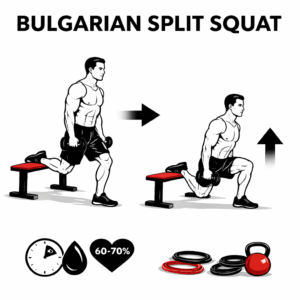
The Bulgarian split squat is one of the most effective single-leg exercises for building lower-body strength.
Although both legs remain in contact with a surface, the front leg performs most of the work while the rear leg provides support.
This allows you to train the quads and glutes with substantial resistance while also challenging your balance and hip stability.
It is a demanding exercise, but it can be adjusted to suit different training levels.
How to Perform a Bulgarian Split Squat
Stand a short distance in front of a bench or stable elevated surface.
Place the top of one foot behind you on the bench while keeping the other foot firmly planted on the floor.
Your front foot should be far enough forward that you can lower your body without your front heel lifting from the ground.
From this position, bend the front knee and lower your body under control.
Allow the rear knee to move toward the floor as you descend.
Once you reach a comfortable depth, drive through the front foot to return to the starting position.
Complete your repetitions on one side before switching legs.
2. Single-Leg Romanian Deadlift
The single-leg Romanian deadlift combines hamstring and glute training with balance and coordination.
It uses the same basic hip-hinge concept as a traditional Romanian deadlift, but performing it on one leg dramatically increases the stability requirement.
This makes it an excellent single leg hamstring exercise for people who want to develop posterior-chain strength while improving control.
How to Perform a Single-Leg Romanian Deadlift
Stand tall on one leg with a slight bend in the knee.
Hold a dumbbell in the opposite hand or use both hands if that feels more comfortable.
Begin pushing your hips backward while your free leg extends behind you.
Your torso should lean forward as your hips travel backward.
Lower the weight toward the floor while maintaining control of your spine and pelvis.
Continue only as far as you can without losing your balance or rotating your hips.
Then drive your standing foot into the floor and bring your hips forward to return to the starting position.
3. Step-Ups
Step-ups are one of the most practical single-leg exercises because they closely resemble everyday movements such as climbing stairs.
They primarily train the working leg while also challenging your balance and coordination.
They can be performed using a box, step, or sturdy bench.
How to Perform a Step-Up
Place one foot firmly on a stable platform.
Make sure the entire foot is supported rather than allowing your heel to hang off the edge.
Push through the working leg and raise your body onto the platform.
Try not to use your trailing leg to jump or push yourself upward.
Once you are standing on the platform, control your descent back to the floor.
Repeat your desired number of repetitions before switching sides.
4. Single-Leg Glute Bridge
The single-leg glute bridge is a simple but effective way to train the glutes and hamstrings without requiring gym equipment.
It is also a useful introduction to unilateral hip-extension training for beginners.
Because your body is supported by the floor, the balance demand is lower than with standing single-leg exercises.
How to Perform a Single-Leg Glute Bridge
Lie on your back with one foot planted firmly on the floor.
Extend the opposite leg while keeping it aligned with your torso.
Brace your core and press through the planted foot to raise your hips.
Continue until your body forms a controlled line from your shoulders toward the working knee.
Squeeze the glute at the top before lowering your hips slowly back toward the floor.
Complete your repetitions on one side and then switch.
5. Pistol Squat
The pistol squat is one of the most advanced exercises on this list.
It requires significant single-leg strength, ankle and hip mobility, balance, coordination, and body control.
In a full pistol squat, you lower your body on one leg while extending the other leg forward.
Because of the demands involved, most people should not expect to perform a full pistol squat immediately.
How to Perform a Pistol Squat
Stand on one leg and extend the opposite leg forward.
Brace your core and begin lowering your body by bending the standing knee and hip.
Keep the extended leg off the floor as you descend.
Lower as far as you can while maintaining control.
Then drive through the standing foot to return to the starting position.
6. Reverse Lunge
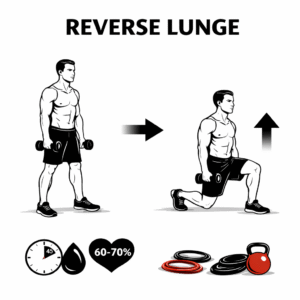
Reverse lunges are a practical single-leg movement that trains the quads and glutes while requiring less forward momentum than a walking lunge.
The backward step can also make the movement feel more controlled for some people.
How to Perform a Reverse Lunge
Start standing with your feet around hip-width apart.
Step backward with one leg.
Lower your body by bending both knees while keeping your front foot firmly planted.
Bring the rear knee toward the floor without forcing it down.
Then push through the front foot and return to the standing position.
Alternate legs or complete all repetitions on one side before switching.
7. Single-Leg Box Squat
The single-leg box squat is useful for developing strength and control while giving you a clear depth target.
The box or bench provides a reference point that can make the movement easier to learn than an unsupported single-leg squat.
It also allows you to gradually increase the difficulty by changing the height of the surface.
How to Perform a Single-Leg Box Squat
Stand in front of a stable box or bench.
Lift one foot from the floor and extend it slightly forward.
Begin lowering your body on the standing leg.
Reach your hips backward and bend your standing knee as you descend.
Lightly touch the box without completely relaxing your body.
Then drive through your standing foot to return to the starting position.
8. Lateral Step-Down
The lateral step-down is particularly useful for training the muscles responsible for controlling your knee and hip while your body moves through a single-leg position.
Unlike forward movements such as lunges and step-ups, this exercise introduces a lateral component.
That makes it a valuable addition when you want more variety in your lower-body training.
How to Perform a Lateral Step-Down
Stand on a stable step or box with one foot near the edge.
Allow the opposite leg to hang slightly off the side.
Bend the knee of your standing leg and slowly lower your free foot toward the floor.
Your goal is to control the descent without allowing the standing knee to collapse inward.
Once your free foot approaches the ground, press through the standing leg to return to the starting position.
9. Single-Leg Calf Raise
Single-leg training should not stop at the hips and thighs.
Your calves contribute to walking, running, jumping, and other lower-body movements, making them an important part of overall leg development.
The single-leg calf raise provides a simple way to train each calf independently.
How to Perform a Single-Leg Calf Raise
Stand on one foot with the ball of your foot positioned on a stable step.
Allow your heel to drop slightly below the level of the step if your mobility allows.
Then press through the ball of your foot and raise your heel as high as you comfortably can.
Pause briefly at the top before lowering slowly.
Complete your repetitions and then switch sides.
10. Skater Lunge
The skater lunge introduces a dynamic, lateral movement that challenges strength, balance, and coordination.
Unlike the other exercises on this list, it can be performed with a more athletic rhythm and can be adapted into a jumping movement for more advanced training.
How to Perform a Skater Lunge
Start standing on one leg.
Reach the opposite leg behind and across your body while lowering into a controlled single-leg position.
Push through your standing foot and move laterally toward the opposite side.
Land softly on the other leg and immediately establish your balance before performing the next repetition.
For a more advanced version, you can add a small lateral hop between repetitions.
Are Single-Leg Exercises Better Than Regular Leg Exercises?
Not necessarily.
Single-leg and two-leg exercises serve different purposes, and there is no reason to treat them as competing approaches.
Exercises such as squats and deadlifts allow you to use both legs together and generally make it easier to move heavier loads. They are valuable for developing overall lower-body strength.
Single-leg exercises place more emphasis on one side at a time and often require greater balance and coordination.
A strong lower-body program can include both.
For example, you might perform squats as your primary strength movement and then use Bulgarian split squats or step-ups as an accessory exercise.
This approach gives you the benefits of bilateral strength work while also giving each leg individual attention.
The question is not whether single-leg exercises are universally better.
The better question is whether they serve a useful purpose in your particular workout.
For many people, the answer is yes.
How to Choose the Right Single-Leg Exercises
Not every single-leg exercise needs to be included in the same workout.
The best choices depend on your current ability, goals, and training experience.
If you are new to unilateral training, start with exercises that give you more stability, such as step-ups, reverse lunges, and single-leg glute bridges.
As you become more comfortable, you can introduce more demanding movements such as Bulgarian split squats and single-leg Romanian deadlifts.
Advanced exercises such as pistol squats and dynamic skater lunges can come later.
Your exercise selection should also reflect what you want to improve.
If you want more quad-focused work, Bulgarian split squats, step-ups, and box squats are useful options.
If you want more single leg glute exercises, Bulgarian split squats, single-leg glute bridges, and step-ups can fit well into your program.
For single leg hamstring exercises, the single-leg Romanian deadlift is one of the clearest choices on this list.
If balance is the priority, controlled single-leg movements such as single-leg deadlifts and lateral step-downs can provide a greater challenge than stable bilateral exercises.
A Simple Single-Leg Workout for Beginners
If you are new to single-leg training, there is no reason to start with the most advanced exercises.
A simple session could begin with step-ups, followed by reverse lunges and single-leg glute bridges.
You might perform two to three sets of each exercise, using a controlled number of repetitions that allows you to maintain good form.
For example:
Step-Ups: 3 sets of 8 to 10 repetitions per leg
Reverse Lunges: 3 sets of 8 to 10 repetitions per leg
Single-Leg Glute Bridges: 2 to 3 sets of 10 to 12 repetitions per leg
You can perform the workout with bodyweight initially.
Once the exercises become comfortable, gradually introduce dumbbells or another appropriate form of resistance.
Single-Leg Exercises for Strength and Muscle
If your main goal is building muscle and strength, resistance becomes increasingly important as your technique improves.
Bodyweight exercises can be challenging when you are new to training, but eventually you may need additional resistance to continue progressing.
Exercises such as Bulgarian split squats, step-ups, reverse lunges, and single-leg Romanian deadlifts can all be loaded with dumbbells.
The key is to increase resistance without allowing your technique to deteriorate.
For muscle development, you should also pay attention to your total training volume.
One hard set is not necessarily enough to create the stimulus you want, while performing excessive sets can make recovery difficult.
A moderate amount of high-quality work, performed consistently, is a more sustainable approach.
Single-Leg Exercises for Balance
If balance is one of your main goals, start by removing unnecessary resistance.
It is tempting to hold heavy dumbbells while trying to improve balance, but this can make it difficult to learn the movement correctly.
Instead, begin with bodyweight.
Exercises such as single-leg Romanian deadlifts, step-ups, lateral step-downs, and single-leg calf raises allow you to practice controlling your body on one leg.
Use a stable object for light support when necessary.
Once your balance improves, you can gradually reduce the support and introduce resistance.
Remember that balance is a skill.
It improves through practice, not simply through making every exercise harder.
How to Progress Your Single-Leg Training
Progress does not always mean adding more weight.
With single-leg exercises, you can also make progress by improving your control, increasing your range of motion, reducing assistance, or performing more repetitions with the same resistance.
For example, someone learning the pistol squat might begin by holding onto a support.
Later, they may perform the movement using a higher box.
Eventually, they may progress toward a lower box and then an unsupported variation.
The same principle applies to single-leg deadlifts.
You might begin with bodyweight, then hold a light dumbbell, and eventually increase the resistance while maintaining balance.
Make one change at a time.
If you increase the weight, repetitions, range of motion, and difficulty simultaneously, it becomes much harder to know what is actually improving.
Common Mistakes With Single-Leg Exercises
One of the most common mistakes is trying to progress too quickly.
Single-leg exercises can expose weaknesses that are difficult to notice during bilateral movements. If you immediately use heavy weights, you may compensate by shifting your torso, twisting your hips, or relying on momentum.
Start with a resistance that allows you to control the movement.
Another mistake is treating balance as the only goal.
You should still be producing force with the working leg. Do not turn every exercise into an attempt to simply avoid falling over.
Your balance should support the movement rather than become the entire movement.
Another common problem is allowing the knee to lose alignment.
The exact position of the knee can vary depending on the exercise and individual anatomy, but you should maintain control rather than allowing the knee to collapse inward without control.
Finally, do not rush the repetitions.
Single-leg exercises often benefit from a deliberate pace because slower movement gives you more time to maintain your position and recognize where you are losing control.
How to Add Single-Leg Exercises to Your Routine
The easiest way to incorporate unilateral training is to add one or two exercises to your existing lower-body workouts.
You do not need to completely rebuild your program.
For example, if your workout already includes squats and Romanian deadlifts, you could add Bulgarian split squats and single-leg calf raises.
If you are training at home, you could use step-ups, reverse lunges, single-leg glute bridges, and single-leg Romanian deadlifts.
If you are more advanced, you might include pistol squat progressions or skater lunges.
Choose movements that complement what you are already doing.
The goal is to fill a gap in your training, not simply make the workout longer.
Final Thoughts
Single-leg exercises deserve a place in many lower-body training programs because they offer something that bilateral movements cannot provide in exactly the same way.
When you train one side at a time, each leg has to contribute more independently. You have to control your balance, stabilize your hips and knees, and produce force without relying as heavily on the other side.
That makes unilateral training useful for building strength, improving coordination, and developing more complete lower-body control.
But you do not need to choose between single-leg exercises and traditional exercises such as squats and deadlifts.
The two approaches can work together.
Use bilateral movements when you want to develop overall strength and move heavier loads. Add single-leg exercises when you want to challenge each side individually, improve balance, or introduce a different training stimulus.
Start with exercises that match your current ability. Step-ups, reverse lunges, and single-leg glute bridges are accessible options for beginners. As your control improves, progress to Bulgarian split squats, single-leg Romanian deadlifts, and other more demanding movements.
Advanced exercises such as pistol squats and dynamic skater lunges should be approached gradually rather than rushed into simply because they look impressive.
The most important part of unilateral training is control.
A slow, stable repetition performed with appropriate resistance is far more valuable than a heavier repetition that forces you to twist, wobble, or compensate.
Give both sides consistent attention, progress gradually, and combine unilateral exercises with the rest of your lower-body training.
Over time, that combination can help you build stronger legs, better balance, and greater confidence in how you move.
Last Updated on September 3, 2026
Written By

Join thousands of readers leveling up their fitness.
Skip the guesswork—get insights on training, health, and the right gear to support your progress.
You may also like
How To Do A Lat Pulldown Correctly
The lat pulldown is one of the best exercises for building a wider, stronger…
10 Different Types Of Deadlifts And Their Benefits
The deadlift is one of the most powerful compound exercises for building…
How to Strengthen Your Knees for Running
Strong, healthy knees are essential for runners, whether you’re logging miles…
Compound vs. Isolation Exercises: What’s the Difference?
When it comes to strength training, all exercises can generally be divided into…
Back Squat Exercise Guide: How to Master Back Squats
The back squat is one of the most effective strength training exercises for…
10 Medicine Ball Ab Exercises You Need To Try
If you’re tired of traditional crunches and planks, it’s time to add some…