

Tight hips can make movement feel harder than it should.
After spending hours sitting at a desk, driving, or staying in the same position for long periods, you may notice stiffness when you stand up or move around. Athletes and regular gym-goers can experience a similar feeling after repetitive training, particularly when the hips are repeatedly asked to move through the same patterns.
The hips are involved in almost everything you do with your lower body. Walking, climbing stairs, squatting, lunging, running, bending, and changing direction all require the hips to move and provide stability.
When your hips feel stiff, everyday movements can feel restricted. You may also find it more difficult to get into comfortable positions during exercise.
That is where hip stretches can be useful.
Regular mobility work can help you move through a comfortable range of motion and may make your hips feel less restricted. The right stretches can target areas such as the hip flexors, glutes, inner thighs, and muscles around the hip joint.
However, stretching should not be about forcing your body into the deepest position possible. A good stretch should be controlled and comfortable enough that you can relax into it without sharp or worsening pain.
This guide covers seven effective hip-opening stretches, including beginner-friendly options and deeper positions for people who already have some mobility experience.
Why Hip Mobility Matters
Your hips are designed to provide both movement and stability.
They help connect your upper and lower body and play an important role in activities ranging from basic walking to strength training and sports.
Good hip mobility does not mean being able to perform extreme stretches. It means having enough comfortable movement to perform the activities you need to do without unnecessary restriction.
For example, adequate hip mobility can make it easier to perform a squat with appropriate technique, take a long stride while walking or running, or move into a lunge position.
On the other hand, spending long periods in one position can make your hips feel stiff. Regular movement and mobility work can be useful ways to break up that stiffness.
Stretching is only one part of the picture. Strength, movement habits, training volume, recovery, and overall activity levels also influence how your hips feel and move.
7 Best Hip-Opening Stretches
The following stretches cover several areas around the hips. You do not necessarily need to perform all seven every time.
Choose the movements that address how you currently feel and fit them into your normal training or mobility routine.
1. Kneeling Hip Flexor Stretch
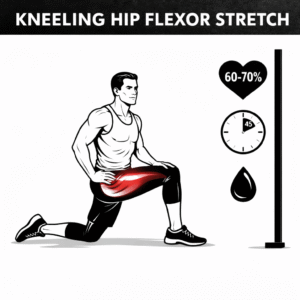
The kneeling hip flexor stretch is one of the simplest places to start if your hips feel tight after sitting for long periods.
The position lengthens the front of the hip while also involving the quadriceps of the rear leg.
It is particularly useful as one of the hip opening stretches for beginners because the position is easy to understand and does not require any equipment.
How to Perform the Kneeling Hip Flexor Stretch
Start by kneeling on your right knee with your left foot planted in front of you.
Your front knee should be positioned comfortably above your ankle. Keep your torso upright rather than leaning forward.
From this position, gently shift your hips forward.
You should feel the stretch toward the front of the hip and thigh of the kneeling leg.
Hold the position for approximately 30 to 45 seconds, then switch sides.
The movement should be gentle. You do not need to push your hips as far forward as possible.
2. Seated Butterfly Stretch
The seated butterfly stretch is a straightforward option for working on the inner thighs, groin, and hips.
It requires no equipment and can easily be performed at home, making it a convenient choice when you want to add a few minutes of mobility work to your day.
How to Perform the Butterfly Stretch
Sit on the floor with your torso upright.
Bring the soles of your feet together and allow your knees to fall outward.
Hold your feet or ankles comfortably and maintain a tall posture.
From there, gently allow your knees to move toward the floor.
You can apply very light pressure with your hands or elbows if it feels comfortable, but there is no need to force your knees downward.
Hold the stretch for approximately 30 to 60 seconds while breathing slowly.
3. 90/90 Hip Stretch
The 90/90 stretch is one of the more effective options for working on hip rotation.
It places your legs in different positions and asks your hips to work through an angle that is not commonly used during everyday movement.
Because of this, it can feel more demanding than a basic seated stretch.
How to Perform the 90/90 Hip Stretch
Sit on the floor and position your front leg so that your knee is bent approximately 90 degrees.
Place the other leg behind you with the knee also bent.
Once you have established the position, sit as evenly as you can and keep your torso controlled.
Lean slightly forward over the front leg to increase the stretch.
Hold for around 45 seconds per side before changing positions.
4. Pigeon Pose
Pigeon pose is a deeper hip stretch that is commonly used in yoga and mobility routines.
It can provide a strong stretch through the glutes and outer hip while also placing the rear leg into a position that involves the hip flexors.
Because it is more demanding than some of the beginner stretches in this guide, it is best approached gradually.
How to Perform Pigeon Pose
Begin from a plank or tabletop position.
Bring your right knee forward toward your right wrist.
Extend your left leg behind you and gradually lower your hips toward the floor.
Keep your upper body supported and adjust your front leg to find a comfortable position.
Hold for approximately 30 to 60 seconds, then switch sides.
5. Figure Four Stretch
The figure four stretch is another accessible option for targeting the glutes and outer hips.
Because you perform it lying on your back, it can be easier to control than some standing or kneeling stretches.
It is also a useful choice for people who prefer a supported position.
How to Perform the Figure Four Stretch
Lie on your back with both knees bent.
Cross your right ankle over your left thigh.
Reach through the space between your legs and hold the back of your left thigh.
Gently pull the left leg toward your chest.
As you do this, you should feel a stretch through the right glute and outer hip.
Hold for approximately 30 to 45 seconds, then switch sides.
Keep your head and shoulders relaxed against the floor.
6. Frog Stretch
The frog stretch is designed to challenge the inner thighs and groin while placing the hips into a wide position.
It can provide a deeper stretch than some of the other exercises in this routine, so it is especially important not to force the range.
How to Perform the Frog Stretch
Start on your hands and knees.
Slowly move your knees outward while keeping your lower legs positioned comfortably behind you.
Once your knees are in a manageable position, gently shift your hips backward.
Keep your torso supported and move slowly.
Hold the position for approximately 30 to 60 seconds.
7. World’s Greatest Stretch
The World’s Greatest Stretch combines several movements into one sequence.
It can involve the hips, hamstrings, and upper body while also adding a gentle rotation through the spine.
Unlike the longer static stretches in this guide, it can work particularly well as part of a warm-up because you move through the position rather than staying completely still.
How to Perform the World’s Greatest Stretch
Begin in a standing position and step your right foot forward into a lunge.
Place your left hand on the floor inside your right foot.
Keep your right foot planted and gradually rotate your torso toward the right.
Reach your right arm toward the ceiling while following your hand with your eyes if comfortable.
Return to the starting position and repeat on the opposite side.
Move slowly and deliberately rather than trying to complete the sequence as quickly as possible.
A 10-Minute Hip-Opening Routine
If you want a simple routine to use several times per week, start with the following sequence.
Begin with the kneeling hip flexor stretch, holding each side for approximately 30 seconds.
Move into the seated butterfly stretch and hold for 30 to 45 seconds.
Next, perform the figure four stretch on both sides.
Follow with the 90/90 hip stretch, spending approximately 30 to 45 seconds on each side.
Finish with several controlled repetitions of the World’s Greatest Stretch on each side.
If you have more time and want additional work for the inner thighs, you can include the frog stretch.
There is no need to force every position. The goal of the routine is to make your hips feel more comfortable and mobile, not to see how deep you can stretch.
Deep Hip-Opening Stretches vs. Beginner Hip Stretches
Not every hip stretch needs to be intense.
If you are new to mobility training, starting with simpler exercises can help you become familiar with the positions before moving into deeper stretches.
The kneeling hip flexor stretch, butterfly stretch, and figure four stretch are relatively accessible starting points.
More demanding positions such as pigeon pose, the frog stretch, and the 90/90 stretch can be introduced as your comfort and control improve.
The important distinction is not whether an exercise is “advanced” or “beginner.” It is whether you can perform the movement comfortably and maintain control.
A deep stretch is not automatically more effective.
The best stretch is one that gives you a useful range of motion without forcing your body beyond what it can comfortably handle.
Hip Opening Stretches for Beginners
If you are completely new to hip mobility work, keep your routine simple.
Start with the kneeling hip flexor stretch, butterfly stretch, and figure four stretch.
These positions allow you to work on different areas without immediately requiring advanced mobility.
Once you become comfortable, introduce the 90/90 stretch and World’s Greatest Stretch.
Deeper positions such as pigeon pose and the frog stretch can come later if they feel appropriate for your body.
There is no advantage to rushing through the progression.
The purpose of beginner hip opening stretches is to build familiarity and consistency first.
How to Build a Simple Hip Mobility Routine
You do not need a 30-minute stretching session every day.
A short, consistent routine can be easier to maintain.
If you are dealing with general stiffness after sitting, you might begin with the kneeling hip flexor stretch, butterfly stretch, and figure four stretch.
Hold each side for approximately 30 to 45 seconds and move slowly between exercises.
If you want a more complete routine, add the 90/90 stretch and frog stretch.
Before a workout, you can use the World’s Greatest Stretch as part of a dynamic warm-up instead of spending a long time holding static stretches.
The right combination depends on what your body needs and what activity you are preparing for.
When Should You Do Hip Stretches?
The best time to stretch depends on the type of stretching you are doing.
Dynamic movements such as the World’s Greatest Stretch can fit well into a warm-up because they allow you to move through different positions without holding one position for a long period.
Longer static stretches can be useful after training or during a separate mobility session.
You can also perform gentle hip stretches during breaks from prolonged sitting.
The important thing is consistency.
There is little value in performing a very long stretching session once every few weeks if you spend the rest of the time doing nothing to address your mobility.
How to Improve Hip Mobility Beyond Stretching
Stretching is only one part of improving mobility.
Strength training through a controlled range of motion can also help you become more comfortable and capable in different positions.
Exercises such as squats, lunges, step-ups, and controlled single-leg movements can all involve the hips while requiring you to produce force.
Regular walking and general movement also matter.
If you spend most of the day sitting, adding short movement breaks throughout the day may be more practical than relying entirely on one stretching session.
Mobility is ultimately about how well you can control movement, not simply how far you can passively stretch.
What Should a Hip Stretch Feel Like?
A normal stretch usually feels like tension or a gentle pulling sensation in the muscles being lengthened.
It should not feel like a sharp, stabbing, or sudden pain.
You should also be able to breathe normally.
If you find yourself holding your breath, gripping the floor, or fighting to stay in the position, the stretch may be too intense.
Reduce the range of motion and see whether the movement becomes more comfortable.
Your goal should be controlled mobility rather than maximum intensity.
Can Hip Stretches Help With Tightness?
Stretching can be useful when your hips feel stiff or restricted.
Regular mobility work may help you become more comfortable in certain positions and maintain a useful range of motion.
However, persistent or significant pain should not automatically be treated as a flexibility problem.
If pain is severe, persistent, worsening, or associated with other symptoms, stretching may not be the appropriate solution.
In those situations, it is better to seek advice from a qualified healthcare professional rather than repeatedly pushing into the painful position.
Common Hip Stretching Mistakes
Forcing the Stretch
One of the biggest mistakes is assuming that more discomfort means a better result.
Stretching should be controlled. You should feel tension, but you should not force your body into a position that causes sharp or worsening pain.
Holding Your Breath
People often tense up when a stretch feels challenging.
Instead, breathe slowly and naturally.
Relaxing into the position can make it easier to maintain control and avoid unnecessary tension.
Rounding the Lower Back
This is particularly common during hip flexor stretches and seated positions.
If you have to dramatically change your posture to reach a deeper position, reduce the range.
Good technique is more important than depth.
Bouncing Into the Stretch
Avoid repeatedly bouncing at the end of your range.
Controlled movement gives you more awareness of your position and makes it easier to recognize when you have reached an appropriate level of tension.
Comparing Your Flexibility to Someone Else
Hip mobility varies significantly from person to person.
Your range of motion can be influenced by anatomy, training history, activity levels, and other individual factors.
Focus on improving your own movement rather than trying to copy someone else’s range.
Final Thoughts
Hip mobility is not about being able to perform the deepest stretch in the room.
It is about having enough comfortable movement to squat, walk, run, train, and perform everyday activities without feeling unnecessarily restricted.
The seven stretches in this guide give you several ways to work on that mobility. The kneeling hip flexor stretch focuses on the front of the hip, while the butterfly and frog stretches work more heavily through the inner thighs and groin. The figure four and pigeon pose provide options for the glutes and outer hips, while the 90/90 stretch challenges hip rotation. The World’s Greatest Stretch brings several movements together and can be particularly useful as part of a warm-up.
You do not need to perform all seven exercises every day.
Choose a few that suit your current needs, perform them with control, and practice them consistently. Start with beginner-friendly positions if your hips are particularly stiff, then gradually introduce deeper or more demanding movements as your comfort and control improve.
Most importantly, do not treat stretching as a competition.
A deeper position is not automatically a better position, and discomfort is not a requirement for progress. Move within a range you can control, breathe normally, and give your body time to adapt.
If you experience persistent or significant hip pain, do not assume that stretching alone will solve the problem. Get the issue assessed by an appropriate healthcare professional so you can understand the cause and choose the right approach.
With consistent mobility work and regular movement, you can build a better foundation for comfortable, capable movement.
Last Updated on August 28, 2026
Written By

Join thousands of readers leveling up their fitness.
Skip the guesswork—get insights on training, health, and the right gear to support your progress.
You may also like
How To Do A Lat Pulldown Correctly
The lat pulldown is one of the best exercises for building a wider, stronger…
10 Different Types Of Deadlifts And Their Benefits
The deadlift is one of the most powerful compound exercises for building…
How to Strengthen Your Knees for Running
Strong, healthy knees are essential for runners, whether you’re logging miles…
Compound vs. Isolation Exercises: What’s the Difference?
When it comes to strength training, all exercises can generally be divided into…
Back Squat Exercise Guide: How to Master Back Squats
The back squat is one of the most effective strength training exercises for…
10 Medicine Ball Ab Exercises You Need To Try
If you’re tired of traditional crunches and planks, it’s time to add some…