

Grip strength is easy to overlook until it becomes the thing holding you back.
You may have strong legs and a powerful back, but if your hands give out before the rest of your body during a deadlift, row, or pull-up, your grip can become the limiting factor. The same thing happens outside the gym. Carrying heavy grocery bags, opening a stubborn jar, holding onto sports equipment, or simply using your hands for long periods all require some level of grip strength.
A stronger grip gives you more than a firm handshake. It helps you hold onto resistance, control equipment, and perform pulling and carrying movements with greater confidence. Your hands and forearms also play an important role in transferring force between your body and whatever you are holding.
The good news is that grip strength can be trained.
You do not necessarily need specialized equipment or a complicated routine. Exercises such as farmer’s carries, dead hangs, plate pinches, wrist curls, and hand grippers can all be used to strengthen different aspects of your grip. You can also build grip strength indirectly through exercises you may already perform, including deadlifts, rows, and pull-ups.
The key is understanding what you are trying to improve and training it consistently.
Why Grip Strength Matters
Your grip is involved in almost every exercise that requires you to hold, pull, carry, or stabilize an object.
In strength training, this becomes particularly obvious during exercises such as deadlifts and rows. Your back and legs may be capable of handling the weight, but your hands and forearms still have to keep the bar securely in place.
When your grip is stronger, you can often maintain your hold for longer and concentrate more effectively on the exercise itself.
Grip strength also matters outside the gym. Carrying bags, moving objects around the house, opening containers, using tools, and participating in recreational activities all involve the hands and forearms.
It is therefore useful to think of grip strength as both a training quality and a practical physical skill.
There is also broader interest in grip strength as a general indicator of physical capability. However, grip strength is only one measure of health and fitness and should not be treated as a standalone measure of overall health.
The Three Main Types of Grip Strength
Understanding the different types of grip can help you choose better exercises.
Crush Grip
Crush grip is the squeezing strength you use when closing your hand around an object.
A handshake is a simple everyday example. In the gym, crush grip is involved when you squeeze a dumbbell, barbell, kettlebell, or other piece of equipment.
Hand grippers are one of the most direct ways to train this type of grip.
Pinch Grip
Pinch grip involves holding an object between your fingers and thumb rather than wrapping your entire hand around it.
Plate pinches are a straightforward example. They force the thumb and fingers to work together to prevent the plates from slipping.
Pinch grip is useful for activities where you need to control thin or flat objects.
Support Grip
Support grip is your ability to hold onto a weight or object for an extended period.
Farmer’s carries and dead hangs are two practical examples.
This type of grip is especially relevant when your hands need to continue supporting a load even after your initial squeezing strength has been used.
Training all three types gives you a more complete approach to grip development.
Best Grip Strength Exercises
You do not need to perform every exercise in every workout. Instead, choose movements that address the type of grip you need to improve.
1. Farmer’s Carry
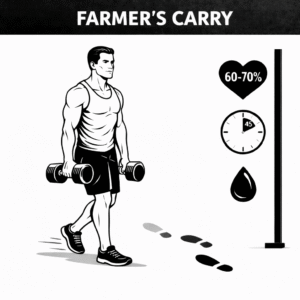
The farmer’s carry is one of the simplest and most effective grip strength exercises.
You simply hold a heavy weight in each hand and walk while maintaining control. Although the exercise looks straightforward, it challenges much more than your hands. Your forearms have to maintain the grip, while your shoulders, core, legs, and upper back help keep your body stable.
It is particularly useful for developing support grip and learning how to maintain tension while moving with a load.
How to Perform the Farmer’s Carry
Choose a pair of dumbbells or kettlebells that you can carry without losing your posture.
Stand tall with the weights at your sides. Keep your chest controlled, shoulders in a natural position, and core braced.
Begin walking with deliberate steps. Avoid leaning from side to side or allowing the weights to swing.
Continue for a set distance or a specific amount of time, such as 30 to 60 seconds.
When your grip starts to fail, set the weights down safely rather than allowing them to fall.
2. Dead Hangs
Dead hangs are a simple way to train your ability to hold your body weight from a pull-up bar.
They are especially useful if you want to know how to improve grip strength for pull ups because the exercise allows you to focus directly on your ability to maintain a hold.
Dead hangs also require your forearms and hands to work continuously rather than repeatedly opening and closing around the bar.
How to Perform a Dead Hang
Grip a secure pull-up bar with both hands.
Allow your body to hang from the bar while keeping your grip firm.
Maintain control through your shoulders rather than simply collapsing into the position.
Hold for as long as you can while maintaining a secure grip and controlled body position.
Rest before repeating.
If a full dead hang is currently too difficult, you can use a supported variation or reduce the amount of body weight being placed through your hands.
3. Plate Pinches
Plate pinches target a different quality of grip by forcing your fingers and thumb to hold the plates together.
They are particularly useful for improving pinch strength and developing stronger hands.
How to Perform Plate Pinches
Take two weight plates and position them together with their smooth sides facing outward.
Grip the plates between your fingers and thumb.
Lift them from the ground and hold them at your side.
Maintain the pinch without allowing the plates to slide apart.
Aim for approximately 30 to 45 seconds per set, depending on the weight and your current ability.
If you are new to the exercise, begin with lighter plates. The goal is controlled grip training, not simply using the heaviest plates available.
4. Towel Pull-Ups
Towel pull-ups combine upper-body pulling strength with a demanding grip challenge.
Instead of holding a conventional pull-up bar, you grip towels that are draped over the bar. Because the towels move slightly and provide a different surface to hold, your hands and forearms have to work harder to maintain control.
This makes the exercise more advanced than a standard dead hang or pull-up.
How to Perform Towel Pull-Ups
Drape two strong towels over a secure pull-up bar.
Grip one towel with each hand and establish a stable starting position.
Pull your body upward while maintaining a firm grip on the towels.
Continue until you reach the top of your available range of motion, then lower yourself under control.
If you cannot perform a full towel pull-up, start with towel-assisted hangs or shorter repetitions.
Do not use weak or unsuitable towels for this exercise. The equipment needs to be secure enough to support your body weight.
5. Wrist Curls and Reverse Wrist Curls
Your forearms contribute heavily to grip strength, so direct forearm training can be useful alongside exercises that require you to hold heavier loads.
Wrist curls train the muscles responsible for wrist flexion, while reverse wrist curls place more emphasis on the muscles responsible for wrist extension.
Training both directions provides a more balanced approach than repeatedly performing only one movement.
How to Perform Wrist Curls
Sit on a bench or chair and rest your forearms on your thighs or a stable surface.
Hold a light barbell or dumbbell with your palms facing upward.
Allow your wrists to move through a controlled range, curling the weight upward before lowering it slowly.
Avoid moving your entire forearm. The movement should come primarily from the wrists.
How to Perform Reverse Wrist Curls
Use a similar setup, but hold the weights with your palms facing downward.
Raise the backs of your hands upward and then slowly lower the weights.
Because the muscles involved can be relatively small, you do not need heavy weights to make this exercise challenging.
Controlled repetitions are more important than loading the exercise excessively.
6. Hand Grippers
Hand grippers are one of the most convenient tools for training crush grip.
They are small, inexpensive, and easy to use at home. Because they require very little space, they can also be incorporated into a short grip-focused session without the need for a full gym setup.
How to Use Hand Grippers
Hold the gripper securely in one hand.
Squeeze the handles together until they meet or you reach the strongest part of your available range.
Release the resistance under control rather than allowing the gripper to snap open.
A starting point of 10 to 15 repetitions per hand can work well.
As your grip becomes stronger, you can gradually increase the resistance.
What Muscles Are Involved in Grip Strength?
Grip strength is not produced by one muscle.
Your fingers, thumb, hands, wrists, and forearms all contribute to your ability to hold an object. The muscles of the forearm are particularly important because many of them control the fingers and wrist.
Your grip also depends on how the resistance is positioned and what type of hold you are using.
For example, holding a heavy dumbbell during a farmer’s carry requires you to maintain a strong closed-hand grip for an extended period. Pinching weight plates challenges the thumb and fingers in a different way. Hanging from a pull-up bar requires you to maintain your hold against your body weight.
This is why a well-rounded grip program should include more than one type of exercise.
How to Improve Grip Strength for Deadlifts
Deadlifts are one of the best opportunities to develop grip strength because you have to hold a heavy bar while your lower body and back produce force.
However, simply deadlifting does not guarantee that your grip will improve at the same rate as the rest of your body.
If your grip repeatedly fails before your legs or back, you can add specific grip work to your training.
Farmer’s carries can help build support grip, while dead hangs can improve your ability to maintain a hold for longer periods.
You can also pay attention to how you grip the bar during your deadlifts. Establish a secure grip before beginning each repetition and avoid allowing the bar to rest passively in your fingers.
As your deadlift becomes heavier, you may eventually choose a different grip strategy depending on your training goals and equipment. However, direct grip training remains useful even when other tools or techniques are used for heavy lifting.
How to Improve Grip Strength for Pull-Ups
Pull-ups require you to support your entire body weight with your hands while also producing enough force to move your body upward.
For many beginners, grip endurance can become a limiting factor.
If your hands give out before your back and arms are sufficiently challenged, start by building your ability to hang from the bar.
Dead hangs are an obvious starting point because they allow you to train the grip without having to perform a complete pull-up.
As your hold time improves, you can introduce assisted pull-ups, controlled repetitions, and eventually more demanding variations.
Towel hangs and towel pull-ups can be added later when you have developed a solid foundation.
The important thing is to progress gradually rather than immediately jumping into advanced grip variations.
How to Improve Grip Strength at Home
You do not need a full gym to improve your grip.
A resistance tool such as a hand gripper can provide direct crush-grip training, while a tennis ball can be used for simple squeezing exercises.
A towel can also be used for wrist and hand work. Twisting a towel as though you are trying to wring out water creates resistance that challenges the hands and forearms.
If you have access to a secure pull-up bar, dead hangs are another excellent option.
You can also use household objects for carrying exercises, provided they are safe to hold and appropriate for the amount of weight you are using.
The most important part of home training is consistency. A few focused sessions each week can be more useful than performing a large amount of grip work once and then stopping for several weeks.
How Often Should You Train Grip Strength?
Grip training does not necessarily need to be performed every day.
Your hands and forearms are involved in many exercises, which means they may already receive considerable training volume from your normal workouts.
If you regularly perform deadlifts, rows, pull-ups, carries, and other pulling exercises, your grip is already being challenged.
Adding direct grip work two or three times per week can be enough for many people.
Start with a manageable amount of training and pay attention to how your hands and forearms recover. If your grip feels constantly fatigued or your performance on your main exercises begins to decline, reduce the additional work.
The goal is to strengthen your grip, not to keep your forearms exhausted.
How to Increase Grip Strength Over Time
Improving grip strength follows the same basic principle as improving other areas of strength: the challenge needs to increase gradually.
You can make an exercise more difficult by increasing the weight, extending the duration of a hold, increasing repetitions, or using a more demanding variation.
For example, if you can comfortably perform a farmer’s carry with a particular weight for 30 seconds, you might eventually carry the same weight for 40 seconds. Once that becomes manageable, you can increase the load and return to a shorter duration.
The same approach works for dead hangs and plate pinches.
With hand grippers, you can move to a stronger resistance once you can consistently complete your target repetitions with good control.
Progress does not need to happen every workout. Small improvements accumulated over time are what matter.
Grip Strength Training Tips
Train More Than One Type of Grip
Do not rely exclusively on squeezing exercises.
Include support work such as carries and hangs, along with pinch exercises and direct crush-grip training.
This gives you a more complete approach to hand and forearm strength.
Increase the Challenge Gradually
Your grip will become stronger when you give it a reason to adapt.
However, increasing the difficulty too quickly can leave your hands and forearms excessively fatigued.
Progress in small steps and maintain control.
Do Not Ignore Recovery
Your forearms may be smaller than the muscles you train during major compound exercises, but they still need time to recover.
If you train grip hard on top of heavy deadlifts, rows, and pull-ups, your total workload can add up quickly.
Give your hands and forearms enough recovery between demanding sessions.
Keep Your Wrists and Hands Mobile
Grip training should not mean keeping your hands clenched all day.
Controlled wrist movements and gentle mobility work can help you maintain comfortable movement in your hands and wrists.
If an exercise causes persistent pain rather than normal muscular fatigue, stop and reassess the movement.
Use Your Regular Workouts to Your Advantage
You do not always need a separate grip workout.
Deadlifts, rows, pull-ups, carries, and other exercises already challenge your ability to hold resistance.
Think of direct grip exercises as additional training that supports your main workouts.
Common Grip Training Mistakes
Training Grip Every Day
Because grip exercises are often quick and easy, it can be tempting to perform them every day.
More is not necessarily better. Your hands and forearms still require recovery, particularly when your regular workouts already contain heavy pulling exercises.
Using Too Much Resistance
Grip exercises can become ineffective when the resistance is so heavy that you cannot maintain proper control.
Start with a manageable level and progress gradually.
Only Training Crush Grip
Squeezing a hand gripper can improve crush grip, but it does not train every aspect of grip strength.
If your goal is overall grip development, include carries, hangs, and pinch exercises as well.
Training to Complete Failure Too Often
You do not need to completely exhaust your grip during every session.
Repeatedly training to failure can create unnecessary fatigue and may affect your ability to perform other exercises.
Quality training with controlled progression is usually a better long-term approach.
Ignoring Your Main Lifts
If your primary goal is to improve deadlifts or pull-ups, your grip work should support those movements.
Do not perform an exhausting grip workout immediately before a heavy pulling session if it causes your grip to fail during the main workout.
Schedule direct grip work in a way that complements your overall training.
Final Thoughts
Grip strength is one of those physical qualities that can have an impact far beyond a single exercise.
A stronger grip can help you hold onto heavier weights, maintain your position during pulling movements, and perform everyday tasks that require your hands and forearms to work for longer periods.
The best way to improve it is not to rely on one exercise.
Build your training around several forms of grip work. Use farmer’s carries and dead hangs to develop support grip, plate pinches to challenge your thumb and fingers, and hand grippers to train crush strength. Add wrist curls and reverse wrist curls when you want more direct forearm work, and use exercises such as towel pull-ups when you are ready for a more demanding challenge.
You can also make your regular workouts part of the process. Deadlifts, rows, pull-ups, and loaded carries naturally place demands on your grip.
Whether your goal is to improve your deadlift, perform more pull-ups, get stronger in the gym, or simply build more capable hands, consistency will matter more than complicated programming.
Start with exercises you can perform well, increase the challenge gradually, and give your hands and forearms enough time to recover.
Over time, those small improvements can add up to a grip that feels stronger, more reliable, and much less likely to be the weak link in your training.
Last Updated on August 28, 2026
Written By

Join thousands of readers leveling up their fitness.
Skip the guesswork—get insights on training, health, and the right gear to support your progress.
You may also like
How To Do A Lat Pulldown Correctly
The lat pulldown is one of the best exercises for building a wider, stronger…
10 Different Types Of Deadlifts And Their Benefits
The deadlift is one of the most powerful compound exercises for building…

How to Strengthen Your Knees for Running
Strong, healthy knees are essential for runners, whether you’re logging miles…
Compound vs. Isolation Exercises: What’s the Difference?
When it comes to strength training, all exercises can generally be divided into…
Back Squat Exercise Guide: How to Master Back Squats
The back squat is one of the most effective strength training exercises for…
10 Medicine Ball Ab Exercises You Need To Try
If you’re tired of traditional crunches and planks, it’s time to add some…