

A strong back does more than make your upper body look bigger. Your back muscles help you pull, lift, stabilize your spine, support your shoulders, and maintain good posture during everyday activities and training.
One of the most effective ways to develop those muscles is through row exercises.
Rows are pulling movements in which you bring resistance toward your torso. While the basic idea is simple, there are many ways to perform a row, and each variation can change how much work is placed on different parts of the back.
A barbell row can be useful when your goal is overall strength and mass. A single-arm dumbbell row allows you to train each side independently. A chest-supported row removes much of the need to stabilize your torso, allowing you to concentrate more directly on the pulling movement. Bodyweight rows offer another option for beginners or anyone looking to improve their foundational pulling strength.
The best approach is not to choose one row and perform it forever. A well-rounded back workout can use different variations to train the muscles from different positions while also giving you options based on your equipment, experience, and goals.
In this guide, we will look at seven effective row exercises, explain the muscles involved, walk through proper technique, and cover the mistakes that can make rows less effective.
What Are Row Exercises?
Row exercises are resistance-training movements based on a horizontal pulling pattern. Instead of pressing a weight away from your body, you pull it toward your torso.
The movement resembles the action of rowing a boat, which is where the name comes from.
Most row variations involve some combination of shoulder extension, elbow flexion, and movement of the shoulder blades. Depending on the exercise, you may also need significant core and lower-back involvement to keep your body stable.
This makes rows valuable for more than simply building a larger back. They can also help develop pulling strength and improve your ability to control your upper body under resistance.
There is no single “best” row for everyone. The right exercise depends on what you are trying to accomplish and how well you can perform the movement.
For example, someone focused on building overall back strength may benefit from a barbell row, while someone who struggles to keep their lower back stable may prefer a chest-supported or seated cable row.
Rows Exercise Muscles Worked
Rows primarily train the muscles responsible for pulling your arms toward your body and controlling your shoulder blades.
The latissimus dorsi, commonly called the lats, are large muscles that run along the sides of your back. They contribute to shoulder movement and play an important role in pulling strength. Depending on your grip and elbow path, rows can place a significant amount of work on the lats.
The rhomboids and trapezius also contribute heavily. These muscles help control the shoulder blades and are particularly involved when you pull your shoulders back during the rowing motion.
The posterior deltoids, or rear shoulders, assist with moving the upper arm backward. They can become more involved when your elbows travel farther away from your torso.
Your biceps and other elbow flexors also contribute because the elbow bends as you pull the weight toward you.
Certain row variations also require your erector spinae and core muscles to work isometrically. These muscles help keep your torso in position while your upper body performs the pulling movement.
The exact amount of work performed by each muscle depends on the exercise, grip, elbow position, range of motion, and technique.
Best Row Exercises to Build a Stronger Back
1. Bent-Over Barbell Row
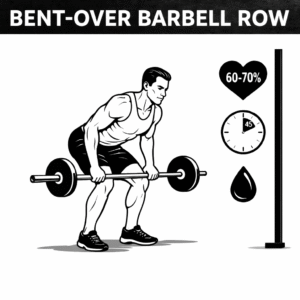
The bent-over barbell row is one of the most recognizable rowing exercises and a long-standing favorite for building back strength.
Because you have to hold a hinged position while pulling the bar toward your body, the exercise challenges the back while also demanding stability from your core and lower body.
It is particularly useful for lifters who want to move progressively heavier loads and develop overall pulling strength.
How to Perform the Bent-Over Barbell Row
Start with the barbell on the floor or in a suitable rack position. Stand with your feet about hip-width apart and grip the bar with both hands.
Push your hips backward and bend your knees slightly as you hinge forward. Keep your spine neutral and brace your core. Your torso should remain stable throughout the exercise.
From this position, pull the bar toward your lower ribcage or upper abdomen. Think about driving your elbows backward rather than simply pulling with your hands.
Pause briefly when the bar reaches your torso, then lower it under control until your arms are extended.
The goal is not to move the weight as quickly as possible. A controlled repetition allows you to maintain your position and keep the back muscles working.
2. Single-Arm Dumbbell Row
The single-arm dumbbell row is one of the most accessible row variations and a particularly useful choice for addressing differences in strength between the left and right sides of the body.
Because each arm works independently, the stronger side cannot compensate for the weaker side in the same way it can during a bilateral exercise.
The exercise can also provide a comfortable way to learn the mechanics of pulling a weight toward your body.
How to Perform the Single-Arm Dumbbell Row
Place one hand and one knee on a bench. Position your other foot firmly on the floor and hold the dumbbell with your free hand.
Keep your back relatively flat and your core engaged. Allow the dumbbell to hang beneath your shoulder.
Pull the dumbbell upward toward your hip while keeping your elbow relatively close to your body. Focus on moving through the back rather than simply bending your arm.
Lower the dumbbell slowly until your arm is extended again.
Complete your repetitions on one side before switching to the other.
3. Inverted Row
The inverted row is a bodyweight pulling exercise that can be adjusted for different strength levels.
It is particularly useful for beginners because the amount of resistance can be changed by altering your body position. It can also be a valuable accessory movement for experienced lifters who want to improve horizontal pulling strength without adding another heavy free-weight exercise.
How to Perform the Inverted Row
Set a bar at an appropriate height in a secure rack or use a suitable suspension system.
Position yourself underneath the bar and grip it with both hands. Extend your legs and keep your body in a straight line from your shoulders through your hips and legs.
Brace your core and pull your chest toward the bar.
At the top, squeeze your shoulder blades together without excessively shrugging your shoulders.
Lower your body under control until your arms are extended.
If the movement is too difficult, bend your knees and bring your feet closer to your body. This reduces the amount of body weight you have to move.
To make it harder, straighten your legs and position your body closer to horizontal.
4. T-Bar Row
The T-bar row is another effective option for building overall back strength and size.
The exercise allows you to use substantial resistance while maintaining a relatively fixed pulling path. Depending on the equipment and grip, you can adjust the emphasis between the upper back and lats.
A narrow or neutral grip generally allows the elbows to stay closer to the body, while a wider grip can place more emphasis on the upper back.
How to Perform the T-Bar Row
Set up on a T-bar row machine or a landmine-style setup.
Stand over the bar and grip the handles securely. Hinge forward while keeping your spine stable and your core braced.
Pull the weight toward your torso, keeping the movement controlled. Think about bringing your elbows backward rather than trying to curl the weight upward.
Pause briefly at the top before lowering the weight.
Because T-bar rows can be performed with relatively heavy resistance, it is especially important to avoid turning the exercise into a momentum-driven movement.
5. Seated Cable Row
The seated cable row is a versatile exercise that works well for both beginners and experienced lifters.
Unlike free-weight rows, the cable provides resistance throughout much of the movement. This can make it easier to focus on the contraction of the back muscles without having to support a heavy dumbbell or barbell in your hands.
It is also easy to adjust the weight and handle position, making the seated cable row useful for different training goals.
How to Perform the Seated Cable Row
Sit at the cable station with your feet supported and your knees slightly bent.
Hold the selected handle and establish a stable starting position. Keep your torso controlled as you pull the handle toward your body.
Drive your elbows backward and bring the handle toward your torso without excessively leaning back.
At the end of the movement, briefly contract the muscles around your shoulder blades.
Return the handle slowly to the starting position while allowing your arms to extend.
Avoid turning every repetition into a rocking motion. Your torso should remain relatively stable so the back muscles are responsible for moving the resistance.
6. Chest-Supported Row
If you find that your lower back becomes tired before your upper back during traditional rows, the chest-supported row can be an excellent alternative.
As the name suggests, your chest is supported by a bench or machine. This removes much of the need to hold a bent-over position, allowing you to concentrate on the pulling movement.
For many lifters, this makes it easier to focus on the back muscles without worrying about maintaining a heavy hip hinge.
How to Perform the Chest-Supported Row
Set an adjustable bench at an appropriate incline and lie face down with your chest supported.
Hold a dumbbell in each hand or use the available machine handles.
Allow your arms to extend toward the floor, then pull the weights upward while driving your elbows backward.
Keep your chest in contact with the bench and avoid using momentum.
Pause at the top of the movement before lowering the weights slowly.
One advantage of this variation is that it makes excessive body movement much more difficult. That can help you learn what a controlled back contraction should feel like.
7. Upright Row
The upright row is different from the other exercises in this list because it is primarily used to train the shoulders and upper trapezius rather than serving as a traditional back row.
This distinction matters when deciding which exercises belong in your back workout.
The upright row involves pulling a barbell, dumbbells, or another form of resistance upward in front of the body. The deltoids and trapezius contribute significantly to the movement.
Because shoulder comfort can vary from person to person, technique and range of motion are particularly important.
How to Perform the Upright Row
Stand tall while holding the weight in front of your body.
Brace your core and keep your torso stable. Pull the weight upward while allowing your elbows to lead the movement.
Do not force the weight higher than your shoulders can comfortably handle. You should also avoid using excessive weight or jerking the resistance upward.
If the movement causes shoulder discomfort, stop and consider a different exercise.
Bonus: Machine Rows for Beginners
Free-weight rows are not the only option for developing a stronger back.
Row machines can be particularly useful for beginners because they provide a more guided movement path. This can make it easier to focus on learning how to pull with the back without worrying as much about balancing a free weight.
A Hammer Strength-style row, for example, allows you to train with substantial resistance while keeping the movement relatively controlled.
Other seated or supported row machines can provide similar benefits, particularly for people who are still developing their technique.
Machines can also be useful when fatigue makes it difficult to maintain the position required for free-weight rows. They do not need to replace free weights entirely, but they can be a practical part of a balanced program.
The best exercise is ultimately the one that fits your goals and allows you to train consistently with good technique.
Form Tips for Better Rows
Good row technique starts before you even begin pulling the weight.
Establish a stable position first. Depending on the exercise, that may mean bracing your core, setting your feet firmly, or keeping your chest against a support.
From there, focus on moving the elbows rather than thinking only about the hands. Your hands are holding the weight, but the back muscles are responsible for much of the pulling action.
Control both directions of the repetition. The lowering phase is part of the exercise, not a break between repetitions.
Your shoulder blades should move naturally, but avoid turning every repetition into an exaggerated shrug. The exact shoulder-blade movement will vary depending on the row variation.
Your grip can also change the feel of an exercise. An overhand grip may place more emphasis on the upper and mid-back in some row variations, while an underhand or neutral grip can allow the elbows to stay closer to the body and may increase the contribution of the lats and biceps.
Most importantly, use a range of motion that you can control. More movement is not automatically better if it causes you to lose your position.
Common Rowing Mistakes to Avoid
Rounding Your Back
A rounded back is one of the most common problems during unsupported row variations.
The solution is not simply to force your chest upward. Instead, establish a strong hip hinge, brace your core, and choose a weight that allows you to maintain your position.
Using Momentum
If your entire torso moves with every repetition, the exercise can become more about moving the weight than training the back.
Reduce the load and slow the movement down. You should be able to identify where the repetition starts, where the contraction occurs, and where the weight returns.
Pulling With the Arms Only
The biceps naturally assist during rows, but they should not be doing all the work.
Think about driving your elbows backward and bringing the resistance toward your torso. This simple adjustment can help you better connect with the muscles of the back.
Flaring the Elbows Excessively
The ideal elbow position depends on the specific row and the area you are trying to emphasize.
Rather than forcing your elbows into a particular angle, use a position that allows your shoulders to remain comfortable while keeping the movement controlled.
Going Too Heavy
Progressive overload is important for building muscle and strength, but increasing the weight at the expense of technique is not productive.
If your posture changes dramatically as soon as you add weight, you may have progressed faster than your technique can support.
How Often Should You Do Row Exercises?
There is no universal number of rowing sessions that works for every lifter.
For many people, training rows two or three times per week can fit effectively into a well-structured program, provided the total amount of back training and recovery are appropriate.
The important consideration is your overall weekly workload.
If you perform several heavy pulling exercises in the same session, you may not need to add numerous row variations. On the other hand, if your program contains relatively little horizontal pulling, adding another row variation on a second training day may make sense.
Pay attention to performance and recovery rather than simply trying to maximize the number of exercises you perform.
Do Rows Build Muscle?
Yes. Rows can be highly effective for building back muscle when they are performed consistently and combined with appropriate resistance, training volume, nutrition, and recovery.
Muscle growth does not come from an exercise simply because it is considered a “back exercise.” Your muscles need enough resistance and repeated training stimulus over time.
This is where progressive overload becomes important.
As you become stronger, you can gradually increase the weight, repetitions, or training volume while continuing to maintain good technique.
The goal is not to make every workout harder at any cost. The goal is to make steady progress while keeping the movement effective.
How to Build a Better Back Workout With Rows
A good back workout does not need to contain seven different rowing movements.
Instead, choose exercises that complement each other.
For example, you might begin with a heavier compound pulling movement, follow it with a row that provides more controlled resistance, and finish with a movement that allows you to focus on a specific area of the back.
You can also alternate variations between workouts.
One training session might use a barbell row and a seated cable row, while another uses a chest-supported row and a single-arm dumbbell row.
This approach gives you variety without turning every workout into an unnecessarily long list of exercises.
Final Thoughts
Rows are among the most useful movements you can include in a back-training program because they allow you to build strength while training the muscles responsible for pulling and controlling the upper body.
The biggest advantage is not that one particular variation is superior to every other option. It is that rows give you a wide range of ways to train the back.
A barbell row can challenge overall strength. A single-arm dumbbell row can help you train each side independently. An inverted row can build foundational pulling ability. A T-bar row allows for heavier loading, while the seated cable row offers consistent resistance and easy adjustments. A chest-supported row reduces the demand on the lower back and allows you to concentrate on the pulling motion.
The upright row is a little different. It is primarily a shoulder and upper-trapezius exercise, so it should not be treated as a replacement for traditional back rows.
Whichever variations you choose, technique should remain the foundation of your training. Keep your torso stable, control the weight, use a comfortable range of motion, and resist the temptation to sacrifice form simply to lift heavier.
A stronger back is built through consistent training, gradual progression, and enough recovery to allow your body to adapt.
Choose the row variations that fit your goals, learn them well, and give yourself time to get stronger. That approach will do far more for your back development than constantly searching for a new exercise.
Last Updated on August 28, 2026
Written By

Join thousands of readers leveling up their fitness.
Skip the guesswork—get insights on training, health, and the right gear to support your progress.
You may also like
How To Do A Lat Pulldown Correctly
The lat pulldown is one of the best exercises for building a wider, stronger…
10 Different Types Of Deadlifts And Their Benefits
The deadlift is one of the most powerful compound exercises for building…

How to Strengthen Your Knees for Running
Strong, healthy knees are essential for runners, whether you’re logging miles…

Compound vs. Isolation Exercises: What’s the Difference?
When it comes to strength training, all exercises can generally be divided into…
Back Squat Exercise Guide: How to Master Back Squats
The back squat is one of the most effective strength training exercises for…
10 Medicine Ball Ab Exercises You Need To Try
If you’re tired of traditional crunches and planks, it’s time to add some…