

Have you ever spent months in the gym, consistently showing up and putting in the effort, only to feel disappointed by the results? Many people assume that building muscle is simply a matter of lifting heavier weights or spending more hours training. While both play an important role, they are only part of the equation. The way you organize your workouts can have just as much influence on your progress as the exercises themselves.
This is where workout splits make a difference.
A workout split is more than just a weekly schedule. It is a structured training approach that determines which muscle groups you train, how often you train them, and how much time they have to recover before the next session. When designed correctly, a workout split helps you balance training intensity with recovery, allowing your muscles to grow stronger without constantly feeling fatigued.
One of the biggest mistakes people make is trying to do everything in every workout. They train every major muscle group in a single session, rush through exercises, and leave the gym feeling exhausted. While this approach may work for complete beginners, it often becomes less effective as training experience increases. As your body adapts, your muscles require more training volume and higher-quality work to continue growing.
Workout splits solve this problem by giving each muscle group dedicated attention throughout the week. Instead of squeezing your entire body into one workout, you can focus on fewer muscle groups during each session, train with greater intensity, and allow adequate recovery before working those muscles again.
Whether your goal is to build lean muscle, increase strength, improve athletic performance, or simply create a more efficient gym routine, understanding workout splits is one of the most valuable steps you can take. The right training structure can help you recover better, perform better, and achieve more consistent results over time.
In this guide, you’ll learn what workout splits are, why they play such an important role in muscle growth, the different types available, and how to choose the one that best fits your goals, schedule, and experience level.
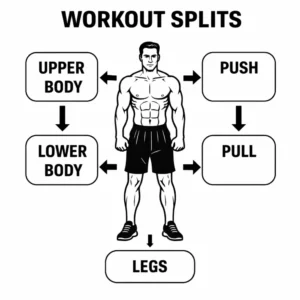
What Are Workout Splits?
A workout split is a training plan that divides your weekly workouts into separate sessions, each focusing on specific muscle groups or movement patterns. Instead of training your entire body during every visit to the gym, you spread your workload across multiple days, allowing each muscle group to receive focused attention while recovering between sessions.
For example, instead of performing chest exercises, back exercises, leg exercises, shoulder exercises, and arm exercises all in one workout, you might dedicate one day to your upper body, another to your lower body, or separate your workouts into push, pull, and leg sessions.
This structured approach provides several important advantages. First, it allows you to perform more quality sets for each muscle group because your energy is concentrated on fewer areas. Rather than rushing through multiple exercises for your entire body, you can focus on proper technique, stronger contractions, and progressive overload.
Second, workout splits support recovery. Every time you lift weights, your muscles experience microscopic damage. During recovery, your body repairs these muscle fibers, making them larger and stronger than before. Training the same muscles every day without adequate rest interrupts this process and can limit your progress.
Finally, workout splits create consistency. Walking into the gym with a clear plan removes uncertainty and helps ensure that every muscle group receives the attention it needs over the course of the week. Instead of randomly choosing exercises each session, you follow a structured program that supports long-term progress.
This is one of the reasons experienced lifters, personal trainers, and competitive athletes rely on workout splits. They understand that muscle growth depends not only on working hard but also on training strategically.
Why Workout Splits Help You Build Muscle
Building muscle is a gradual process that requires three essential elements: sufficient training stimulus, proper recovery, and consistent progression. Workout splits help bring all three together in a way that maximizes results while reducing unnecessary fatigue.
When you dedicate an entire workout to a smaller number of muscle groups, you naturally increase the quality of your training. Instead of conserving energy for a full-body routine, you can perform additional exercises, complete more challenging sets, and maintain better technique throughout the session. This higher training quality often translates into greater muscle stimulation, which is one of the key drivers of hypertrophy.
Recovery is another major advantage. Muscle tissue does not grow while you are lifting weights. Growth occurs afterward, when your body repairs the muscle fibers stressed during training. A well-designed workout split provides each muscle group with enough recovery time before it is trained again, allowing you to return to the gym feeling stronger rather than fatigued.
Another benefit is improved workout performance. Anyone who has attempted to train every major muscle group in one session knows that energy levels begin to drop as the workout progresses. Exercises performed at the end of the workout often receive less effort than those completed at the beginning. Workout splits solve this issue by limiting the number of muscle groups trained during each session, allowing you to maintain higher intensity from start to finish.
Structured training also makes progressive overload easier to achieve. Progressive overload refers to gradually increasing the demands placed on your muscles over time, whether by lifting heavier weights, performing more repetitions, improving exercise technique, or increasing training volume. Since workout splits organize your exercises consistently from week to week, tracking improvements becomes much simpler.
Different Types of Workout Splits
There is no single workout split that works best for everyone. The ideal training split depends on your experience level, recovery ability, weekly schedule, and fitness goals. Someone who is just starting their fitness journey has different needs than an experienced lifter training five or six days each week.
The good news is that there are several proven workout splits that have helped countless people build muscle and strength. Understanding how each one works will help you choose a routine that fits your lifestyle while maximizing your results.
Full Body Split
A full body split is one of the simplest and most effective training methods, especially for beginners or anyone with a busy schedule. Instead of focusing on individual muscle groups, each workout includes exercises for the entire body.
A typical week might look like this:
- Monday: Full Body
- Wednesday: Full Body
- Friday: Full Body
During each session, you’ll usually perform one or two exercises for your chest, back, shoulders, legs, and core. Since every muscle group is trained multiple times each week, this split provides frequent practice with compound movements while allowing plenty of recovery between workouts.
For beginners, this approach is extremely valuable. Learning proper exercise technique requires repetition, and training each muscle group several times per week helps reinforce movement patterns while building a solid strength foundation.
Another advantage is flexibility. If you occasionally miss a workout, you are less likely to neglect a particular muscle group because every session covers your entire body.
The main limitation appears as you become more advanced. As your strength increases, you’ll need more exercises and training volume for each muscle group. Trying to fit everything into one workout can result in very long sessions that become physically and mentally exhausting.
Upper and Lower Split
Once you’ve developed a solid foundation, an upper and lower split is often the next logical step. Rather than training your entire body in every workout, you dedicate separate days to your upper body and lower body.
A common weekly schedule looks like this:
- Monday: Upper Body
- Tuesday: Lower Body
- Thursday: Upper Body
- Friday: Lower Body
This split allows you to spend more time on each muscle group without making workouts excessively long. On upper body days, you can focus on your chest, back, shoulders, and arms. Lower body days emphasize your quadriceps, hamstrings, glutes, calves, and core.
One of the biggest advantages of this routine is its balance. Each muscle group is typically trained twice per week, a frequency that many coaches consider highly effective for muscle growth. At the same time, every muscle receives enough recovery before being challenged again.
The upper and lower split is also highly adaptable. Whether your goal is building muscle, increasing strength, or improving athletic performance, the routine can easily be modified by adjusting your exercise selection, training volume, and intensity.
For people who can consistently train four days each week, this is often one of the best workout splits for muscle growth because it balances workload, recovery, and progression exceptionally well.
Push Pull Legs Split
The Push Pull Legs split, commonly known as PPL, has become one of the most popular workout splits among intermediate and advanced lifters. Rather than organizing workouts by muscle groups alone, it separates exercises based on movement patterns.
Push workouts focus on muscles responsible for pushing movements, including the chest, shoulders, and triceps.
Pull workouts target muscles involved in pulling movements, including the back, rear shoulders, and biceps.
Leg workouts are dedicated to the lower body, including the quadriceps, hamstrings, glutes, calves, and often the core.
A typical six-day schedule looks like this:
- Monday: Push
- Tuesday: Pull
- Wednesday: Legs
- Thursday: Push
- Friday: Pull
- Saturday: Legs
- Sunday: Rest
One reason this split is so effective is that muscles working together are trained together. For example, your chest and triceps naturally work during pressing exercises, making it logical to train them in the same session.
Another major benefit is training frequency. Each muscle group is usually trained twice every week while still receiving several days to recover before the next workout.
This balance between volume and recovery makes the Push Pull Legs split one of the best workout splits for muscle growth, particularly for individuals who can commit to training five or six days each week.
Even if six workouts aren’t realistic, the structure remains effective. Many people successfully run a three-day Push Pull Legs routine by completing one cycle each week, making it suitable for busy schedules as well.
Body Part Split
The body part split, often referred to as the “bro split,” has been popular in bodybuilding for decades. In this approach, each workout is dedicated almost entirely to one major muscle group.
A typical schedule might include:
- Monday: Chest
- Tuesday: Back
- Wednesday: Shoulders
- Thursday: Arms
- Friday: Legs
This style allows you to perform a high amount of volume for a single muscle group during one session. Because your attention is focused on one area, you can include several different exercises from multiple angles while maintaining excellent exercise quality.
Many experienced bodybuilders enjoy this split because it allows them to thoroughly fatigue individual muscles while keeping workouts mentally focused.
However, there is one important consideration. Since each muscle group is generally trained only once per week, total training frequency is lower than other workout splits. Recent research suggests many lifters achieve better muscle growth by training muscles at least twice weekly, especially when total training volume is similar.
That doesn’t mean the body part split is ineffective. For advanced lifters capable of generating very high training intensity, it can still produce excellent results. The key is ensuring sufficient weekly training volume and consistently applying progressive overload.
Five Day Muscle Group Split
If you’re searching for workout splits 5 day routines, this option combines many advantages of both the upper and lower split and the traditional body part split.
Rather than isolating every muscle group individually, related muscles are paired together to create efficient, productive workouts.
A common weekly schedule includes:
- Monday: Chest and Triceps
- Tuesday: Back and Biceps
- Wednesday: Legs
- Thursday: Shoulders
- Friday: Arms and Core
This arrangement allows enough training volume for each muscle group without requiring six gym sessions every week.
Many experienced lifters prefer this structure because it provides flexibility. Weak muscle groups can receive additional attention while still allowing adequate recovery before the following week.
For individuals who genuinely enjoy spending time in the gym and can consistently commit to five training sessions, this split offers an excellent balance between muscle specialization, recovery, and sustainable progression.
How to Choose the Best Workout Split
Now that you’re familiar with the most common workout splits, the next step is determining which one is right for you. Many people spend too much time searching for the “perfect” training program when they should be looking for the one they can follow consistently. The truth is that the best workout split is the one that matches your lifestyle, recovery ability, and long-term fitness goals.
One of the first factors to consider is your weekly availability. If you can realistically train only three days a week, a full body split is often your best option because it allows you to train every major muscle group multiple times without feeling rushed. On the other hand, if you can consistently commit to four or five sessions each week, an upper and lower split or a five-day muscle group split provides more opportunities to increase training volume while maintaining proper recovery.
Your experience level also plays an important role. Beginners benefit from practicing foundational exercises more frequently, which is why full body and upper and lower splits are commonly recommended during the first several months of training. These routines emphasize compound movements like squats, bench presses, rows, and overhead presses, helping you build strength while improving technique.
Intermediate and advanced lifters often require more volume to continue making progress. As your body adapts to resistance training, you can no longer rely on a few sets of each exercise to stimulate muscle growth. Splits like Push Pull Legs or a dedicated five-day routine make it easier to perform additional quality sets without extending every workout beyond a reasonable length.
Common Mistakes That Limit Muscle Growth
Even with one of the best workout splits, progress can stall if certain mistakes become part of your routine. Many lifters blame their program when the real issue is how they apply it.
One of the most common mistakes is changing workout splits too often. It’s easy to become excited about a new routine after seeing someone else’s results online, but constantly switching programs makes it difficult to measure progress. Muscle growth requires consistency over months, not constant variety every few weeks. Give your chosen split enough time to work before deciding whether it needs adjustment.
Another mistake is training with too much volume and too little recovery. More exercises do not automatically produce more muscle. In fact, excessive training volume can reduce workout quality, slow recovery, and eventually lead to overtraining. Focus on performing enough quality work rather than simply spending more time in the gym.
Many people also neglect progressive overload. Performing the same exercises with the same weight for months will eventually lead to a plateau. Your muscles need a reason to adapt. That doesn’t necessarily mean adding large amounts of weight every week. Sometimes increasing one repetition, improving exercise technique, slowing the tempo, or adding an extra set is enough to continue progressing.
Poor exercise selection is another issue. While isolation exercises certainly have value, every effective workout split should be built around compound movements that train multiple muscle groups simultaneously. Exercises like squats, deadlifts, bench presses, overhead presses, pull-ups, and rows should form the foundation of most muscle-building routines. Isolation exercises can then be used to provide additional volume where needed.
Tips for Getting the Most Out of Your Workout Split
A well-designed workout split becomes even more effective when paired with smart training habits. Tracking your workouts is one of the simplest ways to monitor progress. Recording the exercises you perform, the weights you lift, and the number of repetitions completed allows you to see improvements over time and identify areas that need additional attention.
Nutrition should also support your training efforts. Building muscle requires adequate protein, enough calories to fuel recovery, and a balanced diet that provides essential vitamins and minerals. Without proper nutrition, even the best workout split will struggle to produce noticeable results.
Sleep deserves equal attention. Most muscle repair and recovery occur while you sleep, making quality rest one of the most powerful tools for improving performance. Consistently getting seven to nine hours of sleep each night helps optimize recovery, hormone production, and energy levels for future workouts.
Conclusion
Workout splits are much more than a way to organize your weekly gym schedule. They provide the structure that allows your training, recovery, and progression to work together toward a common goal. Whether you’re just beginning your fitness journey or looking to take your muscle-building results to the next level, choosing the right split can have a significant impact on your success.
The best workout splits are not necessarily the most complicated ones. They are the routines that fit your schedule, match your experience level, and allow you to train consistently while recovering properly. A beginner may achieve outstanding progress with three full body workouts each week, while a more experienced lifter may thrive with a Push Pull Legs or five-day muscle group split. Neither approach is inherently better. What matters most is following a program you can sustain over the long term.
As your strength increases and your goals evolve, your workout split can evolve with you. The principles remain the same: train with purpose, apply progressive overload, prioritize recovery, and stay consistent. When these elements work together, your workouts become more productive, your performance continues to improve, and muscle growth becomes a natural result of smart, structured training.
Instead of chasing the latest fitness trend or switching routines every few weeks, commit to a workout split that supports your lifestyle and goals. With patience, dedication, and a well-planned approach, you’ll build more than muscle. You’ll develop a sustainable training routine that delivers results for years to come.
Last Updated on August 27, 2026
Written By

Join thousands of readers leveling up their fitness.
Skip the guesswork—get insights on training, health, and the right gear to support your progress.
You may also like

How To Do A Lat Pulldown Correctly
The lat pulldown is one of the best exercises for building a wider, stronger…

10 Different Types Of Deadlifts And Their Benefits
The deadlift is one of the most powerful compound exercises for building…

How to Strengthen Your Knees for Running
Strong, healthy knees are essential for runners, whether you’re logging miles…

Compound vs. Isolation Exercises: What’s the Difference?
When it comes to strength training, all exercises can generally be divided into…

Back Squat Exercise Guide: How to Master Back Squats
The back squat is one of the most effective strength training exercises for…

10 Medicine Ball Ab Exercises You Need To Try
If you’re tired of traditional crunches and planks, it’s time to add some…